SASSA Older Persons Grant 2026: Eligibility, Amounts & How to Apply
The SASSA Older Persons Grant, also called the old age pension or old age grant, provides monthly financial assistance to qualifying people aged 60 and older in South Africa. This guide explains the 2026 payment amounts, who may qualify, the means test and how to apply. If you need to check the separate SRD relief programme instead, our SASSA status check for SRD R370 guide covers those monthly results.
From April 2026, the Older Persons Grant has a maximum monthly rate of R2,400 for ages 60 to 74 and R2,420 for ages 75 and older. These are the published maximum rates; the amount a person qualifies for depends on the applicable eligibility rules and means test. You do not need to guess from a payment screenshot or a social media post.
Opens the SASSA services website to read current grant requirements. Do not enter personal details on this guide.
Older Persons Grant at a glance
What Is the SASSA Older Persons Grant?
The SASSA Older Persons Grant is a government-funded social assistance payment for older people who meet the qualifying conditions. It is commonly called the SASSA old age pension, although it is not a retirement savings account or a pension built up through contributions at work. SASSA administers the grant under South Africa’s social assistance system.
The grant is intended to provide ongoing income support when an older person has limited financial resources. It is assessed against defined conditions, including age, residence, immigration or citizenship status, existing personal grants and financial means. Turning 60 is the minimum age requirement, but it does not automatically guarantee approval or the maximum monthly payment.
Who Is the Older Persons Grant Designed to Help?
The age requirement is 60 years or older. Qualifying applicants may be South African citizens, permanent residents or recognised refugees living in South Africa. The applicant and, where applicable, their spouse must satisfy the means test. A person ordinarily cannot receive another personal social grant for themselves at the same time, and being maintained in a state institution can affect eligibility.
These are the broad rules, not the full eligibility assessment. For example, a person with a small private retirement income may still need a proper means-test assessment instead of assuming that any outside income disqualifies them. Our detailed eligibility and 2026/27 means-test sections follow later in this guide.
Important distinction
Being 60 or older makes you old enough to apply; it is not proof that your application will be approved. SASSA considers the other qualifying conditions and the financial information provided.
Older Persons Grant vs a Private Pension
A means-tested social grant funded through the state. You do not qualify by showing years of contributions to a private retirement fund; you qualify by meeting the social grant rules.
Retirement income from an employer, pension fund, annuity or other private arrangement. It may be counted when SASSA assesses your income and assets for the grant.
A private pension does not automatically rule out an Older Persons Grant. What matters is whether the total income and assets assessed under the applicable rules remain within the qualifying limits. We explain these limits and practical examples in the means-test section rather than treating every pension payment as an automatic rejection.
Older Persons Grant vs the SRD R370 Grant
These are different programmes with different purposes and procedures. The Older Persons Grant is an age-based, means-tested social grant for people aged 60 and older. The SRD R370 programme is separate temporary income relief with its own application, verification and monthly-status process. The monthly SRD status results are not a way to check whether an Older Persons Grant application has been accepted.
If you are helping an older relative, make sure you first identify which grant they applied for. The correct office, application status process and supporting documents can differ by programme. Do not enter an identity number, banking PIN or one-time password into a general information article or an unofficial form.
How Much Is the SASSA Older Persons Grant in 2026?
The Older Persons Grant amount in 2026 depends on the beneficiary’s age and their assessed entitlement. From 1 April 2026, the published maximum payment for ages 60–74 is R2,400 a month. From age 75, the published maximum is R2,420 a month. The extra R20 is an age-related supplement, not a separate application or a second grant.
Older Persons Grant Payment Amounts for Ages 60–74 and 75+
| Age group | Maximum amount per month | Annual total at maximum rate* |
|---|---|---|
| 60 to 74 years | R2,400 | R28,800 |
| 75 years and older | R2,420 | R29,040 |
*Annual totals simply multiply the maximum monthly rate by 12; they are illustrations, not a guarantee of 12 payments or the full rate for any individual. The actual approved amount and payment history may differ.
Someone who turns 75 enters the higher age category. The additional amount is R20 per month above the standard maximum rate. It does not make the recipient eligible for two Older Persons Grants, and the means test still matters.
When Did the April 2026 Increase Take Effect?
The 2026/27 budget increased the Older Persons Grant by R80 per month from April 2026. For ages 60–74, the standard maximum rose from R2,320 to R2,400. For ages 75 and older, the higher maximum rose from R2,340 to R2,420. This is why older articles using pre-April rates no longer give the correct amounts for the current grant year.
| Age group | Before April 2026 | From April 2026 | Increase |
|---|---|---|---|
| 60–74 | R2,320 | R2,400 | +R80 |
| 75+ | R2,340 | R2,420 | +R80 |
The revised rate is applied through the normal grant payment system for qualifying beneficiaries. An existing recipient should not have to submit a new grant application merely to receive a general government-approved rate increase. If an amount differs from what you expect, check the beneficiary’s individual grant record with SASSA rather than assuming an announcement applies identically to everyone.
Will Every Older Persons Grant Recipient Receive the Full Amount?
Not necessarily. R2,400 and R2,420 are maximum monthly figures. The grant is subject to an income-and-assets means test, including relevant information about a spouse where applicable. A person whose finances allow a reduced payment may receive less than the headline maximum. A person who does not meet the qualifying conditions may be refused.
For instance, an older person with a modest private pension should not simply subtract that pension from R2,400 or R2,420 and assume the remainder is their grant. SASSA’s calculation follows the applicable rules and the declared financial circumstances. Nor should someone add an R20 supplement to an SRD R370 payment; the supplement belongs to the higher age tier of the Older Persons Grant.
What matters most: First identify the correct age band, then check the person’s eligibility and assessed income/assets. The next sections of this guide explain who qualifies, which financial limits apply and which documents help SASSA assess an application. The current year’s exact payment days are covered separately in the payment-date section, not guessed from a fixed monthly rule.
Who Qualifies for the Older Persons Grant?
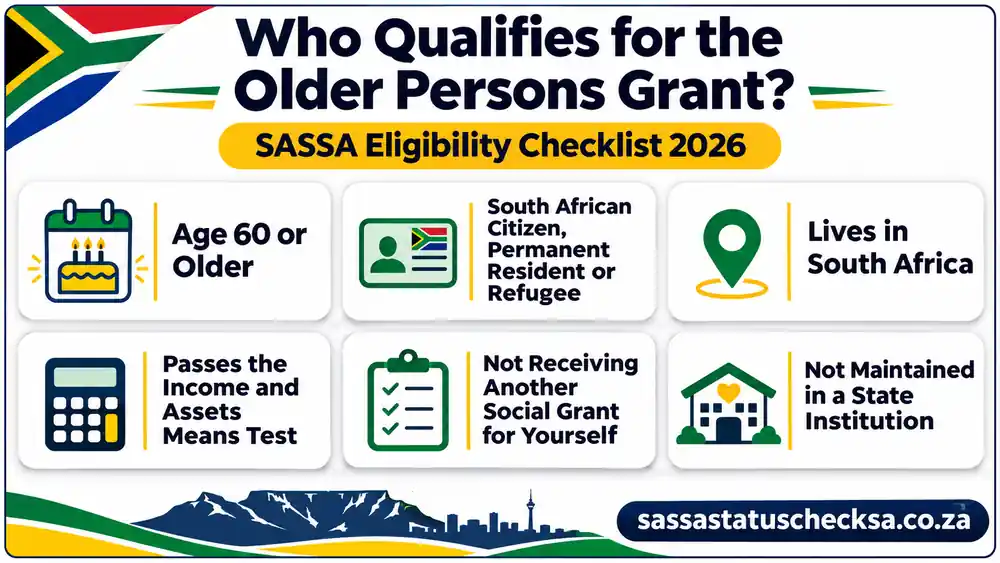
To qualify for the Older Persons Grant, you must be at least 60 years old and meet SASSA’s other conditions, including the income-and-assets assessment. The grant is meant for older people with limited financial means, but reaching the required age is only the first step. Citizenship or residence status, personal social grants and your living arrangements also matter.
The basic rules apply across South Africa. Whether you live in a large city or a rural community, SASSA still needs to check the applicant’s circumstances and, if married, the spouse’s relevant financial information. The following checks can help you prepare without mistaking a simple age test for a full eligibility decision.
Minimum Age and Residency Requirements
Applicants must be 60 or older. A person who is 59 does not yet meet the minimum age, even if they have already stopped working or receive a small private retirement payment. Someone who has turned 60 may apply if the other conditions are met; there is no upper age limit. Being 75 or older affects the maximum payment tier explained earlier, but it does not remove the means test.
The applicant must live in South Africa and hold a qualifying status: South African citizen, permanent resident or recognised refugee. A recognised refugee is not automatically excluded simply for not being a South African citizen, but SASSA will require acceptable documentation for the relevant status. The documents section later in this guide explains the proof usually requested.
Turning 60 soon?
You can start gathering documents before your birthday, but do not treat preparation as an application already submitted. SASSA assesses the actual application under the age and other conditions in force when it is made.
Other Social Grants and State-Funded Institutions
A person ordinarily cannot receive the Older Persons Grant while already receiving another social grant for themselves. That rule is different from living in a household where another person gets a grant: for example, an older relative is not automatically disqualified merely because a child in the home receives a Child Support Grant in that child’s name.
SASSA also requires an applicant not to be maintained or cared for in a state-funded institution. This is more specific than simply living in some form of supported accommodation. If an applicant lives in a residential care setting, ask SASSA how the institution’s funding and the person’s circumstances affect eligibility rather than assuming that every care home is treated identically.
Someone who needs another person’s regular assistance should also ask about Grant-in-Aid. That is a supplementary benefit with its own conditions for eligible recipients of certain primary grants; it is not permission to collect two unrelated personal social grants. We explain related review and care considerations in the later guidance.
Married Applicants and Spouse’s Financial Information
If you are married, the means test considers the combined relevant income and assets of you and your spouse. This applies even when only one spouse is old enough to request an Older Persons Grant. It is a common mistake to list only the 60-year-old applicant’s pension and forget the spouse’s salary, savings or property interests.
The combined limits for married applicants are different from the single-person limits. The figures do not mean that a married couple automatically receives two grants: each applicant must independently meet the applicable age and other requirements. Your marriage and financial circumstances should be declared accurately, including any change such as widowhood or separation. SASSA may request documents to assess an unusual situation.
Older Persons Grant Eligibility Checklist
Before preparing an application, use this brief list as a self-check, not a guarantee of approval:
- You have already reached your 60th birthday.
- You are a South African citizen, permanent resident or recognised refugee living in South Africa.
- You are not currently receiving another ordinary social grant for yourself.
- You are not maintained or cared for in a state-funded institution.
- Your income and assets, together with your spouse’s if married, fit the applicable means-test rules.
- You can provide truthful identity, financial and household information for SASSA to assess.
If you are uncertain about one condition, do not guess or hide information. Ask SASSA to assess your particular situation. Meeting this checklist still does not determine your individual grant amount; the financial test below helps explain why.
SASSA Older Persons Grant Means Test 2026/27
The SASSA Older Persons Grant means test checks whether an applicant has income or assets above the permitted limits. It is not just a question about whether you have a job. A small retirement pension, savings, investments, rental income and a spouse’s financial position can all affect the assessment. SASSA uses the information and supporting documents to decide eligibility and, where relevant, the approved amount.
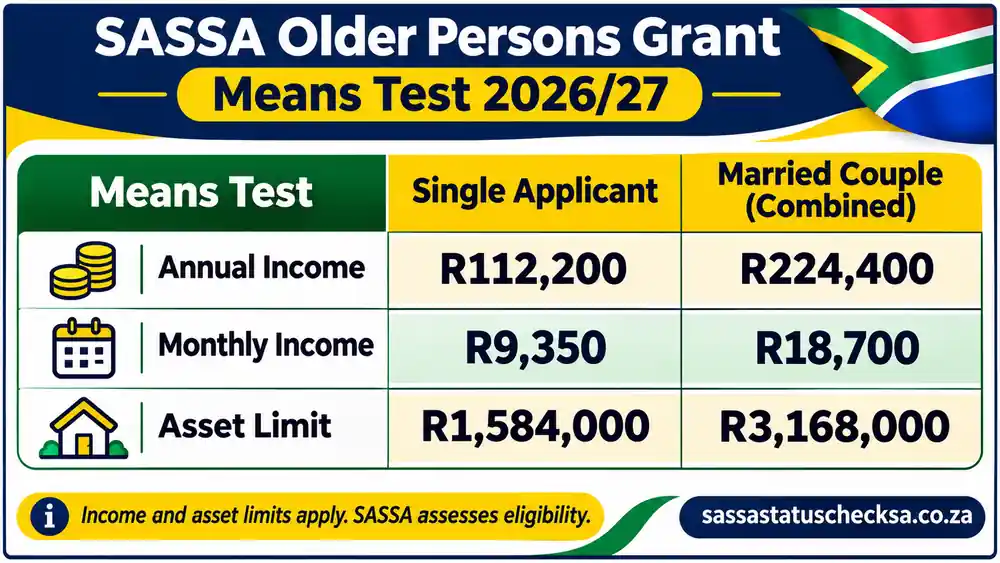
Use the 2026/27 figures below rather than limits copied from older grant articles. National Treasury’s 2026 Estimates of National Expenditure sets the income and asset thresholds for the Older Persons programme. Having income or assets below a headline limit is not a standalone promise of approval: all the other grant rules still apply.
Older Persons Grant Income and Asset Limits for 2026/27
| Financial measure | Single applicant | Married couple (combined) |
|---|---|---|
| Annual income threshold | Less than R112,200 | Less than R224,400 |
| Monthly income equivalent* | R9,350 | R18,700 |
| Asset ceiling | R1,584,000 | R3,168,000 |
*Monthly figures are annual income thresholds divided by 12 for easy comparison; the official Treasury programme description expresses the limits annually. Income must be below the stated limit. Assets must not exceed the stated ceiling. Actual SASSA assessment takes applicable rules and evidence into account.
For a married applicant, the figures refer to the couple’s combined qualifying finances, not a separate R224,400 income allowance for each spouse. The higher limits for married couples do not remove the need to disclose both spouses’ financial information.
What Counts as Income in the Means Test?
SASSA may assess more than a monthly wage. Relevant income can include earnings from work or self-employment, a private pension or annuity, rental income, interest and other qualifying investment returns. The assessment may also take account of a spouse’s income where the applicant is married. You should declare your circumstances accurately even when the money is irregular or comes from more than one source.
Receiving a private pension does not by itself make an older person ineligible. For example, someone living on a modest employer pension may still be within the income limits. The issue is the total assessable means and whether the person meets all other conditions, not simply the existence of a pension payment.
Certain deductions or exclusions may be permitted under the relevant rules. Do not assume that every deduction appearing on a bank statement can be subtracted, or that every deposit is automatically treated as ordinary income. Bring the records SASSA requests so its officials can determine the correct assessed amount.
Which Assets Count, and Is Your Own Home Excluded?
The asset test looks at qualifying holdings such as savings and cash investments, shares, relevant endowment assets and property that is not the applicant’s occupied home. It can also include holdings or rights belonging to a spouse. SASSA may ask for supporting statements, ownership records and valuations, so relying only on a bank account balance can give an incomplete picture.
The property an applicant and spouse own and occupy as their home is generally excluded from the adult-grant asset calculation under the applicable means-assessment regulations. A second home, vacant property or rental property is a different matter and may count. Any outstanding bond and other details must be assessed under the rules rather than by guessing the value yourself.
A home does not automatically make you ineligible
An older person who lives in a home they own should not assume its full value automatically counts against the R1,584,000 or R3,168,000 asset ceiling. Equally, owning property elsewhere should not be ignored when declaring assets. SASSA must assess the actual ownership and living arrangements.
Simple Means-Test Examples for Single and Married Applicants
These examples illustrate which limits to compare. They are not calculations of benefit amounts, and they do not establish entitlement without SASSA’s full assessment.
| Situation | Comparison | What it suggests |
|---|---|---|
| Single applicant, age 67, private pension of R4,000/month, assets below limit | R48,000/year is below R112,200. | May meet the income threshold; SASSA must assess other income, assets and eligibility. |
| Married applicant, combined assessable income R19,000/month | R228,000/year is above R224,400. | Appears above the married income threshold; do not assume approval from age alone. |
| Single applicant, very low income but countable assets R1,650,000 | Assets exceed the R1,584,000 ceiling. | Low income alone would not satisfy the separate asset test. |
| Older applicant living in a home they own, with little cash savings | Occupied-home treatment may exclude its value. | Check any other countable assets and the rest of the eligibility requirements. |
Examples use simplified financial assumptions and deliberately omit the exact grant amount: only SASSA can determine the amount and eligibility from a complete application.
Does a Private Pension Reduce the Older Persons Grant?
It can affect the assessment. Some older people qualify for less than the published maximum because the Older Persons Grant follows a means-tested, potentially sliding-scale calculation. However, you should not simply subtract a private pension from R2,400 or R2,420 and call the result your grant. The real calculation depends on the applicable regulations and SASSA’s assessment of qualifying income and circumstances.
If you receive pension payments, prepare the pension statement and any related records. If you are married, prepare your spouse’s financial details as well. People with assets close to the ceiling should be particularly careful to distinguish their occupied home from other countable property instead of making a blanket assumption about all assets.
Before you apply: Check the correct 2026/27 limits, list all income sources and financial assets accurately, and collect documentation that can support each declaration. The next section explains the documents SASSA commonly requests, followed by the application process for older people and authorised representatives.
What Documents Are Needed for an Older Persons Grant?
Before starting an Older Persons Grant application, prepare evidence of who you are, where you live and your financial circumstances. SASSA uses these documents to check your identity, confirm that you meet the qualifying conditions and complete the means test. Getting them together first can reduce repeat visits or requests for missing information.
You do not need every document in the same situation. For example, proof of a private pension matters only if you receive one; a divorce order is relevant only if you are divorced. Use the checklist below as a preparation guide, then confirm any office-specific or case-specific requirement with SASSA.
Identity Documents and Proof of Address
Bring your South African 13-digit bar-coded ID book or accepted identity document, such as a valid smart ID card, where applicable. Permanent residents and recognised refugees should bring the current identification or residence-status documents that SASSA accepts for their category. If the details on a document have changed, ask SASSA which supporting proof is required.
You should also prepare proof of residence. A recent municipal account, utility bill, lease or other accepted address document may help, but the precise evidence depends on the applicant’s circumstances. Someone living with relatives or without an account in their own name should ask the office what supporting declaration or alternative proof it will accept rather than assuming they are ineligible.
Bring originals and usable copies
Take the original documents you have and copies where available. SASSA may request certified copies or verification in a particular case. Do not hand over originals to an unofficial intermediary or send ID scans through a social-media contact.
Bank Statements, Income and Assets Evidence
For the means test, prepare bank statements covering the previous three months and supporting proof for any income you receive. This may include employment income, rental receipts, dividends, annuity payments or a private pension. If you have no private pension, you do not need to invent pension documents; explain your actual situation when SASSA asks.
You may also be asked for records of savings, investments and relevant property or other assets. Those records help SASSA distinguish assets that count in the assessment from items that may be excluded by the applicable rules, such as an occupied primary home in circumstances covered by those rules. Do not assume that a bank balance alone proves eligibility or that every item someone owns is counted in the same way.
If you previously worked and have relevant Unemployment Insurance Fund information or a discharge certificate, take it when applicable. An old-age grant applicant who has never been formally employed would not be expected to produce a former employer’s certificate that does not exist.
| Document or information | When it matters | Preparation tip |
|---|---|---|
| Accepted identity and residency proof | Every applicant | Bring your ID or qualifying status documentation; ask about alternatives if missing. |
| Proof of where you live | Every applicant | Prepare a valid address record or ask SASSA what declaration is accepted. |
| Bank statements | For the financial assessment | Have statements for the previous three months ready. |
| Income, private pension and asset records | If income or assets are held | Declare your actual income and holdings; bring evidence relevant to your case. |
| Marriage, divorce or spouse-death documents | When relevant to marital status | Include spouse details and estate records if SASSA requests them. |
| UIF or former employer documentation | If previously employed and applicable | Use an existing UIF record or discharge certificate rather than substituting an unrelated paper. |
This is a practical overview of the documents mentioned in South African government guidance. SASSA can request additional information to verify an individual application.
Marriage, Spouse and Special-Circumstance Documents
Applicants who are married should be prepared to supply their marriage details, their spouse’s identification and relevant financial information. A spouse’s income and assets can affect a means-tested decision, even where only one person is applying for the Older Persons Grant. If separated or divorced, bring the relevant official evidence and explain the circumstances to SASSA.
If a spouse died recently, officials may request a death certificate and estate paperwork, including a will or estate distribution documents where relevant. Government guidance specifically highlights additional paperwork where a spouse died within the previous five years. This is conditional: a single applicant whose spouse has not died does not need a deceased-spouse file.
For a person who cannot attend the SASSA office because of illness or frailty, keep a written authorisation and any medical explanation ready for an appointed helper. The next section explains how to check the representative procedure with the office before someone travels on your behalf.
What If You Do Not Have an ID or a Required Document?
A missing ID does not always mean you must abandon your application. South African government guidance describes an alternative process involving a SASSA-prescribed affidavit made before a Commissioner of Oaths, a sworn statement from a reputable person who can verify your name and age, and identity-verification steps handled with SASSA and Home Affairs. These are not substitutes you should prepare casually without asking which prescribed forms are required.
Where an ID is missing, SASSA may take fingerprints and refer the applicant to the Department of Home Affairs to obtain valid identification while the grant application is considered. Following up on the ID is important; failing to obtain it when required can affect the grant later. For other missing records, such as a bank statement or proof of residence, ask SASSA what alternative evidence it will accept for your circumstances.
Before you leave home: make one folder containing identity or status documents, address proof, three months of bank statements, financial evidence, marital records if relevant, and written authorisation if somebody will assist you. Keep an extra copy of any document handed in.
How to Apply for the SASSA Older Persons Grant
The most clearly documented route for an old age pension application is through a SASSA office, where staff can assist with the form, documents and eligibility checks. SASSA has also operated an online services portal that lists Older Persons Grant services. Because availability of particular online transactions can change, use the active government portal or confirm with SASSA before relying on an online submission.
Whether you apply at an office or use a currently supported online route, the application must contain accurate information and relevant documents. Applying is free. A receipt or reference confirms submission; it does not mean the grant has already been approved.
Applying at a SASSA Office: Step by Step
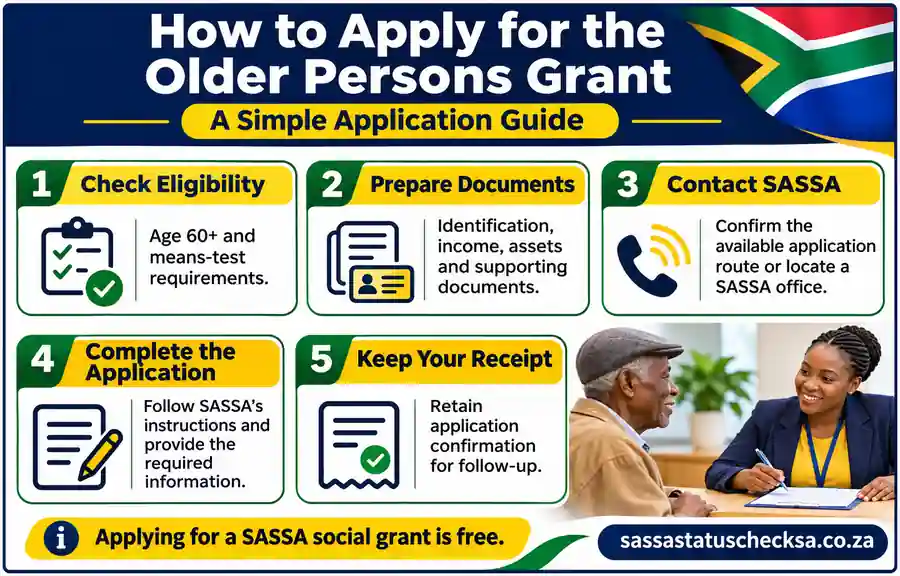
Use these steps when choosing the in-person route. Office hours and arrangements vary by location, so confirm the nearest office and its visiting arrangements before travelling, especially if you need assistance with mobility.
- Find the correct SASSA office. Contact SASSA on 0800 60 10 11 to confirm an appropriate service point and whether an appointment, particular application day or other arrangement applies.
- Prepare your documents. Bring your accepted ID or alternative evidence, proof of residence, bank statements, income-and-asset information and any relevant marital or representative documents listed in the section above.
- Tell the official you want the Older Persons Grant. Make it clear that you are applying for the regular age-based social grant, not the separate SRD R370 relief programme.
- Complete the required application process. An official will guide you through the application and may interview you, confirm your details and arrange any required identity checks. Follow the instructions given for the official form.
- Declare your financial circumstances accurately. Include relevant income, private pension details, assets and spouse information where applicable. Ask for clarification before signing if you do not understand a declaration.
- Keep proof of submission. Request and retain the dated receipt or reference issued for your application. It helps if you later need to ask SASSA about the application or supply a missing document.
Try to keep your contact details current and reachable, so SASSA can request outstanding information if necessary. The application outcome and expected processing period are covered separately in the next section of this guide.
Can You Apply for the Older Persons Grant Online?
An online route has existed, but it should not be treated as permanently guaranteed. SASSA’s services website has offered registration and Older Persons Grant services, and government communications previously announced online applications for this grant. The availability of an individual submission screen, however, can change during maintenance or service updates.
If you prefer to investigate digital submission, start by checking services.sassa.gov.za, confirm that you are on SASSA’s genuine services website, and look for the Older Persons Grant option currently offered to your account. Follow only the instructions actually presented there. If the service does not offer a working application route, contact SASSA for current instructions or use an office rather than trusting a third-party form that asks for your ID and banking details.
Do not confuse the two application systems
The general Older Persons Grant and the SRD R370 relief grant are different programmes. A page intended only for SRD applications or SRD status checks is not a substitute for an Older Persons Grant application.
Can Someone Apply on Behalf of an Older Applicant?
Yes, there are arrangements for an applicant who is too ill or frail to attend the office. Government guidance says a family member or friend may apply on the person’s behalf with a letter from the applicant and/or a doctor’s note explaining why they cannot visit. SASSA may also need to verify the helper’s identity and authority to act.
Before sending somebody to an office, ask SASSA exactly which written authorisation, identity documents and medical evidence are required for your situation. A helper should describe their role honestly and provide the applicant’s real details. Do not assume that being a relative alone gives unrestricted permission to sign documents, change bank accounts or collect payments.
The procedure for applying on someone’s behalf is not necessarily the same as the later procedure for collecting an approved grant. Payment-authorisation arrangements are addressed under the payment methods section of this article.
How to Avoid Application Delays and Keep Your Receipt
Many unnecessary follow-up visits begin with missing documents, incomplete declarations or contact details that cannot be used. Check the identity number and spelling of names against the original document, give the correct address, declare relevant income honestly and confirm whether extra spouse records are needed before leaving the office.
- Check the details you submitted: names, ID or permit information, address, contact number and relevant marital status.
- Keep a dated receipt or reference: store it with your documents rather than relying on memory or an informal agent’s message.
- Respond only through verified SASSA channels: if more information is requested, check the request with SASSA before sharing sensitive documents.
- Ask what remains outstanding: if SASSA says a document is missing, obtain the specific requirement rather than repeatedly submitting an unrelated form.
The receipt is evidence of the application process, not a promise of immediate payment. If you are waiting for a decision, use the appropriate Older Persons Grant contact route; do not use an SRD R370 monthly status result as proof of progress on this separate grant.
Is the SASSA Older Persons Grant Application Free?
Yes. Applying for the Older Persons Grant is free. You do not need to pay an individual to obtain a SASSA application form, secure a queue position or guarantee approval. A private person who asks for money to release a grant payment or demands an OTP should be treated with suspicion.
For questions about office arrangements or grant requirements, contact the SASSA toll-free enquiry line 0800 60 10 11. Keep your ID number, banking information and any verification codes out of messages to strangers and out of this website’s contact forms. Applications and personal verification belong with SASSA’s authorised channels.
Next step after applying: keep your reference and watch for communication from SASSA. The following section explains the processing period, approvals, unsuccessful applications and what to do when a decision needs further attention.
How Long Does Older Persons Grant Approval Take?
After you apply for the SASSA Older Persons Grant, your application must be assessed against the age, identity, residence and means-test requirements. The government advises that processing may take up to three months. That is a processing guideline, not a promise that every applicant will receive an answer on a particular day or get paid in the next monthly cycle.
Keep the receipt or reference supplied when you applied. It helps SASSA locate your record if you need to ask about progress. Submitting all the required documents can prevent avoidable delays, but it does not guarantee approval.
How Long Does SASSA Take to Process an Older Persons Grant Application?
The official time guidance is up to three months from application. During that period, SASSA may need to confirm identification, check declared income and assets, or request another document. Where information is missing or inconsistent, a decision or payment arrangement can take longer to resolve.
Application date and payment date are different
The date on your application receipt matters because an approved grant is generally payable from the application date. However, that does not mean cash will reach your account on the same date or that an unapproved application will generate a payment. SASSA must first approve the application and process the payment.
If you applied recently, use the receipt to record the date and reference rather than relying on a verbal estimate of when you will be paid. If SASSA asks for more information, respond through its official channel and retain copies of what you submit.
How to Check Your Older Persons Grant Application Outcome
Use your SASSA application receipt or reference when asking for an update. You can follow up with the office where you applied, or ask SASSA through its official assistance channels which current service is available for checking an Older Persons Grant application. The toll-free SASSA contact number published by government is 0800 60 10 11.
Be specific about your application type. The SRD R370 status check is a different programme and should not be presented as the way to look up an Older Persons Grant application. A message about an SRD month being approved, pending or declined does not answer whether an old age pension application has been accepted.
Before contacting SASSA, note the submission date, any documents requested and the last message you received. Never send your ID photo, banking information, OTP or card PIN to an unofficial website or person who claims to speed up approval.
If Your Older Persons Grant Is Approved, When Does Payment Start?
The government states that, if approved, the Older Persons Grant is payable from the date on which you applied. If a decision takes several weeks or months, this may mean that an approved beneficiary receives amounts due for an earlier period after the application date. SASSA calculates the actual entitlement and arranges the disbursement.
For example, a person who applied in September and was approved in November might be entitled to payment covering an eligible period starting from their September application date. This is an illustration of the back-payment principle, not a promise of three full monthly payments, a particular amount or a specific November payday. The decision, applicable monthly grant rate, means-test assessment and processing information determine what SASSA pays.
What to confirm after approval
- Which date SASSA recorded as your application date and the effective date of the approved grant.
- Whether the full or an assessed reduced grant amount is payable in your case.
- Which payment method or bank account SASSA has on record and whether any verification is outstanding.
- When any first payment or amount owed from an earlier approved period is expected to be available.
What If Your Older Persons Grant Application Is Declined?
If SASSA refuses the application, it should give you written reasons for the decision. Read the reason before choosing the next step. An identity-record error, missing information or an income/assets decision may require different supporting documents or explanations.
Government guidance says that an applicant who disagrees with a refused Older Persons Grant application can appeal within 90 days of being notified, through the prescribed process involving the Minister of Social Development or the national Department of Social Development. Follow the appeal instructions on the actual refusal notice and ask SASSA or DSD for the current submission method. Keep the letter, original application receipt and evidence supporting your objection.
Do not use the SRD R370 monthly appeal portal as a substitute. That service is for decisions concerning the separate Social Relief of Distress programme. This page describes a regular Older Persons Grant application refusal; its appropriate appeal route must be checked with SASSA and DSD.
What to Do if Approval or the First Payment Seems Delayed
First determine whether the application is still being assessed, has been approved, or has been refused. That distinction matters more than simply counting the days since you visited an office. An application that is not yet approved cannot be treated as a missed ordinary pension payment.
- No decision yet: Contact SASSA with your receipt, check whether any verification or additional document is outstanding, and ask how the application is progressing.
- Approved but no first payment: Confirm the recorded payment method, account or Postbank details, the applicable payment cycle and whether any first-payment processing is still outstanding.
- Written refusal received: Check the stated reason promptly and note the 90-day appeal period rather than waiting until it passes.
- Unexpected request for a fee: Do not pay an individual to release, approve or accelerate your grant. The official grant application service is free.
Bring the application reference and relevant proof when seeking assistance. It is safer to have an authorised SASSA official investigate an unresolved issue than to submit a second application or repeatedly change banking details without being advised to do so.
SASSA Older Persons Grant Payment Dates and Methods
The Older Persons Grant payment dates for 2026/27 are set by SASSA as part of the regular social grant calendar. Older Persons grants usually lead the monthly sequence, followed by Disability and Children’s grants on separate days. The exact dates can change when a special operational arrangement is announced, so it is safer to use the confirmed schedule rather than assume payment always falls on the first or second working day.
The calendar below focuses on the closing months of the 2026/27 financial year. If you have not yet been approved for an Older Persons Grant, the listed payment dates do not mean you will automatically be paid on those days.
Older Persons Grant Payment Dates for November 2026 to March 2027
SASSA’s original annual calendar was published in March 2026. The November date was subsequently revised because of the November 2026 local government elections. The other dates shown below follow the approved published schedule as of 2 November 2026.
| Grant month | Payment date | Status or context |
|---|---|---|
| November 2026 | Friday, 30 October 2026 | Revised date, moved ahead of the election period |
| December 2026 | Wednesday, 2 December 2026 | Published regular schedule |
| January 2027 | Tuesday, 5 January 2027 | Published regular schedule |
| February 2027 | Tuesday, 2 February 2027 | Published regular schedule |
| March 2027 | Tuesday, 2 March 2027 | Published regular schedule |
For the complete April 2026–March 2027 calendar, including Disability and Children’s Grants and any subsequently confirmed changes, see our SASSA payment dates guide. The calendar is separate from the SRD R370 payday process, which does not give every applicant the same fixed payday.
Why Was the November 2026 Older Persons Grant Paid in October?
SASSA moved the November 2026 Older Persons payment from the originally scheduled 3 November to Friday, 30 October 2026. The change followed operational planning ahead of the 4 November local government elections. Disability grants moved to 2 November and Children’s grants to 3 November.
This was a once-off scheduling adjustment, not a permanent change to how often the Older Persons Grant is paid. The 30 October payment relates to the November grant month; it does not mean that November beneficiaries are owed an extra grant merely because the payment arrived in October.
Special review-case date: 5 November 2026
SASSA separately identified 5 November for beneficiaries whose grants were subject to the specific review arrangements. It was not a second universal Older Persons Grant payday. If you received an official review notice, follow SASSA’s instructions rather than treating that date as proof of an extra payment.
How Can You Receive Your Older Persons Grant Payment?
Once your application is approved, SASSA uses the payment method on the beneficiary’s record. The government describes payment by electronic deposit into a bank or Postbank account, by available designated cash collection arrangements, and by certain institutional methods where relevant. Not every method is available in every area, and the current local arrangements should be confirmed before travelling to a pay point.
| Payment method | What to check | Important distinction |
|---|---|---|
| Personal bank account | Recorded beneficiary account details and bank processing | Normal bank fees and account conditions may apply |
| Postbank account/card | Whether your current card can access the Postbank account | Old Gold Cards were phased out; affected users need the replacement process |
| Designated cash collection or pay point | Whether an official collection location currently serves you | Availability, dates and collection rules must be confirmed with SASSA |
| Approved institutional or representative arrangement | What SASSA has formally authorised for the beneficiary | A family member cannot simply claim someone else’s grant without the appropriate authority |
Beneficiaries should be able to confirm their own approved payment route through SASSA. Avoid giving your PIN, bank card, identity number or any verification code to someone offering to collect a payment on your behalf. If you cannot collect personally, ask SASSA how its formal procurator or authority arrangement applies.
Postbank Black Card, Gold Card Changes and Bank-Account Updates
Postbank and SASSA set 31 August 2026 as the final migration deadline from older SASSA Gold Cards to Postbank Black Cards. The old cards were being phased out, which could prevent affected beneficiaries from accessing money with the old card. Importantly, losing access through an expired or phased-out card is not the same as losing eligibility for the grant.
If you still have an old card that no longer works, seek the current Postbank replacement procedure or an officially available alternative account arrangement. The replacement process described by Postbank was free; do not pay unofficial intermediaries or share your PIN. Beneficiaries who already use a working private bank account do not automatically need a Postbank card.
Changing the bank account or payment method for a regular Older Persons Grant is a separate SASSA administrative task. Ask a SASSA office or its official channels what authorised form and bank proof are required, and when the update may take effect. Do not use an SRD R370 banking-details form or SMS link merely because an online guide mentions it; SRD follows a different payment-update process.
What to Do if Your Older Persons Grant Payment Is Late or Missing
A payment problem can have several causes. First check whether the grant has actually been approved, whether the payment date for the relevant month has arrived and whether your chosen bank or payment channel has processed the amount. A card that does not work, an unverified account change, a review notice and a grant suspension are not identical problems and should not receive the same advice.
- Check the correct month’s official date. Remember that the November 2026 Older Persons payment was scheduled for 30 October, not the original 3 November date.
- Confirm payment access. Check your account or approved payment channel, and whether your bank card is active. A closed or inaccessible card is not by itself proof that SASSA never released the money.
- Check for a SASSA notice. If a grant review, life-certificate requirement or other verification request was sent, follow its official instructions. The detailed rules on reviews and suspensions are covered in the next article section.
- Ask the correct provider for help. For a Postbank card/PIN/access problem, start with Postbank’s official support; for approval, recorded details or unexplained grant-payment issues, contact SASSA and have your grant reference ready.
- Record what happened. Keep the month, expected amount, date checked, error message and case or reference number. Do not submit sensitive documents to an unrelated website or a social-media contact.
When the payment date has passed and the amount still cannot be accessed, SASSA’s government-listed toll-free number is 0800 60 10 11. Describe whether the problem is a grant decision, a payment-release issue, an account detail, or a card transaction. Getting the distinction right helps avoid repeated visits and unnecessary changes to your record.
Why Can an Older Persons Grant Be Suspended or Stopped?
An approved Older Persons Grant can continue while you qualify, but approval does not remove the need to respond to SASSA or report important changes. A grant might be reviewed, a payment might be temporarily held or suspended, or a grant might lapse. Those are not the same event. Knowing which one happened helps you take the correct next step.
A late bank deposit is not, by itself, proof that a grant has been cancelled. Before submitting a new application or changing an account, first find out whether SASSA has issued a review notice, recorded a suspension, or needs additional information from you.
How and Why Does SASSA Review an Older Persons Grant?
SASSA may review eligibility when information suggests that income, assets, household circumstances, residency or other qualifying facts have changed. Reviews can also confirm that the right person is still receiving the grant. A review is a check of continuing entitlement; it does not automatically mean you did something wrong or that the grant has permanently ended.
For example, a new pension, employment income, changed marital circumstances or missing financial information may lead SASSA to request updated evidence. When a beneficiary is selected for review, SASSA may ask for an ID, recent bank statements, pension or payslip records, proof of residence and relevant marital documents. The exact list depends on the individual case and the notice received.
Review notice? Act on the notice itself
Read the reason, deadline and required documents carefully. Confirm the request through an official SASSA office or its toll-free line, 0800 60 10 11. Respond within the timeframe given; missing a review appointment may interrupt payment even when you believe you still qualify.
Life Certificates and SASSA e-Life Certification
A life certificate is a way to confirm that a beneficiary is still alive. SASSA may require it as part of ongoing grant administration, particularly where payments are handled through certain channels or a representative. The agency has also introduced e-Life Certification options for supported beneficiaries, with identity checks handled through its authorised systems.
Do not assume that one unverified WhatsApp message is an authentic life-certificate request. Check notices against SASSA’s actual contact details and current instructions. If you receive an official request with a deadline, comply through the channel SASSA specifies. Beneficiaries who cannot use a digital channel should ask their nearest SASSA office about an approved assisted alternative or authorised representative. Do not share an OTP or biometric information with an intermediary.
What Can Cause an Older Persons Grant Suspension?
Suspension means the grant payment may be stopped while a problem is investigated or dealt with; it should not be treated as identical to permanent cancellation. Documented reasons can include failing to cooperate with a review, missing requested evidence, financial circumstances changing enough to affect eligibility, misrepresentation, or an error in the original grant decision.
If a review is underway, SASSA may also delay a payment while it verifies information. The practical next step is to ask whether the record says under review, payment delayed or suspended, and request the reason in writing or through an official reference. Those distinctions determine whether you must supply documents, resolve an identity check or challenge an administrative decision.
When Does an Older Persons Grant Lapse or End?
A lapsed grant is no longer active under the applicable grant rules. Government guidance identifies events such as the death of a beneficiary, certain extended absences from South Africa, and a grant remaining unclaimed for three consecutive months. Admission to a state-funded or state-contracted care institution can also affect payment or eligibility; the applicable rules may involve a reduced amount rather than the same outcome in every institution.
This is different from waiting a few days after the monthly payday to withdraw funds from an active bank account. If you are worried about a grant that has not been claimed for several months, contact SASSA to check its actual recorded status before assuming the money can simply be collected later or that the grant has automatically restarted.
| What SASSA says | What it generally means | Practical next step |
|---|---|---|
| Review requested | Eligibility or identity information needs checking. | Follow the official notice; prepare the specified evidence. |
| Payment delayed | A payment has not become accessible as expected; the reason may still be unclear. | Check the payment channel, monthly date and SASSA record before changing details. |
| Grant suspended | A grant payment has been interrupted after a qualifying issue or administrative decision. | Get the reason and ask SASSA how to correct it or request restoration. |
| Grant lapsed or cancelled | The previous grant entitlement is no longer active under the applicable rules. | Ask which review, restoration, challenge or new application route applies. |
The table explains common administrative terms; only SASSA can confirm the status and remedy for an individual grant.
How to Respond to a Grant Review Notice
If SASSA contacts you for a review, deal with the instruction as early as possible. Prepare the documents requested rather than assuming every review needs the same paperwork. Older applicants or caregivers may need a SASSA-approved representative if attending in person is not possible.
- Verify the notice. Confirm it is from SASSA, identify the office or secure service and record the date by which you must respond.
- Check what is being reviewed. Ask whether the issue concerns income, pension records, spouse’s details, identity, residency, life certification or another specified item.
- Bring the requested evidence. This can include ID, bank statements for relevant accounts, proof of income, address and marital documents, depending on the notice.
- Explain any change accurately. Report changed circumstances with the necessary proof rather than concealing a new pension, employment or household change.
- Keep your reference. Retain receipts, review correspondence and any reference number in case a payment remains delayed afterward.
If the beneficiary is frail, bedridden or unable to attend, contact SASSA about an authorised procurator or assisted procedure. A relative should not simply use the beneficiary’s grant card, credentials or verification codes without the formal authority required by the payment or review process.
Can a Suspended or Lapsed Older Persons Grant Be Restored?
Restoration may be possible depending on why a grant was stopped, when SASSA made the decision, the information now supplied and the legal rules governing that situation. A beneficiary who missed a review may need to complete that review. Someone whose circumstances no longer meet the eligibility conditions may instead need a different decision or fresh assessment.
Do not rely on one universal online claim that every restoration must happen within exactly 30 or 90 days: different notices and types of decision may involve different time limits. Contact SASSA promptly after receiving a notice, ask for the written reason and the deadline that applies to your case, and follow the official review, restoration or appeal procedure. An unsuccessful initial grant application has its own appeal rules; it is not the same as restoring an already approved grant.
Keep the right records: your ID, application or grant reference, SASSA decision or review notice, any recent documents requested and proof of prior communication. Ask for confirmation that the update has been recorded before assuming payments will restart.
Frequently Asked Questions About the Older Persons Grant
These answers address practical questions about age, private pensions, grant reviews and applications. They relate to the regular Older Persons Grant, not the separate SRD R370 monthly status or appeal process. Open a question to read the answer.
Can I apply for the Older Persons Grant when I am 59?
No. You must be at least 60 years old when applying. You can prepare identification and financial documents before your birthday, but being almost 60 does not create early eligibility. Approval also depends on residence, grant conditions and the means test.
Do I have to reapply for the Older Persons Grant every year?
Not ordinarily. An approved Older Persons Grant can continue while you remain eligible, without a completely new annual application. But SASSA can conduct reviews and require updated information or life certification. Always respond to an official request rather than assuming there is nothing left to do.
Can I get the SASSA old age pension if I receive a private pension?
Possibly. Receiving a small private pension does not automatically prevent you from qualifying. You must declare it because it can count in the means test, alongside other relevant income and assets. A full, reduced or unsuccessful grant decision depends on SASSA’s assessment of your circumstances, not just the existence of a pension payment.
Does my husband’s or wife’s income affect my Older Persons Grant?
Yes, where the rules require a combined assessment, your spouse’s income and assets are relevant to the married-applicant means test. Provide truthful information about marital status, pensions, earnings and assets. The guide’s means-test section explains the separate 2026/27 limits for single and married applicants.
What if I do not have a South African ID or one document is missing?
Do not assume you cannot start asking for help. The government describes an alternative declaration and identity-verification process for some applicants without a standard ID. Contact SASSA about the precise forms, supporting statements and Home Affairs steps that apply to your case. Never invent an ID number or submit someone else’s documents.
Can a family member apply for or collect the grant on my behalf?
Where an applicant is too old or ill to visit the office, SASSA may allow a properly supported representative application. Collection or other administration can require a formally recognised procurator or power of attorney. Being a relative alone is not permission to use someone’s card, PIN or personal verification codes. Ask SASSA which authorisation and documents are needed.
Can I get Grant-in-Aid together with the Older Persons Grant?
Some beneficiaries who already receive the Older Persons Grant and require regular assistance with daily living because of a physical or mental condition may also qualify for Grant-in-Aid. It is a separate supplementary benefit with its own assessment and conditions; it is not automatic for everyone over 75. Ask SASSA what supporting medical or functional evidence is required.
What should I do if SASSA asks me for a life certificate or e-Life Certification?
Verify that the notice is genuine, read its deadline and follow the current SASSA-approved certification channel. SASSA has supported e-Life Certification for eligible users, but not everyone must follow exactly the same digital or office procedure. If you cannot use the service, contact an authorised SASSA office for assistance. Never send an OTP to a person contacting you through an unofficial message.
How can I appeal if my Older Persons Grant application is declined?
Ask for SASSA’s written decision and reasons. Government guidance says a person who disagrees with an unsuccessful Older Persons Grant application may appeal to the Minister of Social Development through the national Department of Social Development, generally within 90 days of being notified. Follow the appeal instructions relevant to this regular grant; the SRD R370 monthly appeal portal is a different process.
When will I receive my first Older Persons Grant payment after approval?
The government advises that processing can take up to three months. If approved, the grant is generally payable from the application date, but the day the first amount becomes accessible depends on processing and payment arrangements. Keep your dated receipt and contact SASSA if the payment does not appear when the agency says it should.
SASSA Older Persons Grant: What to Do Next
In summary: The SASSA Older Persons Grant provides monthly financial support to qualifying people aged 60 and older. The maximum 2026/27 amounts are R2,400 for ages 60–74 and R2,420 from age 75, but the means test and other eligibility requirements determine individual entitlement. Before applying, check the income and asset limits, prepare your identity and financial documents, and follow a current SASSA-approved application route. Keep your receipt, follow up on any application decision or missing payment through official channels, and respond promptly if SASSA requests a grant review. The correct next step depends on whether you are applying, awaiting approval or already receiving payments.
Grant rules and administrative procedures can change. For a decision about your own record, confirm the applicable requirements with SASSA on 0800 60 10 11 or at an authorised SASSA office. This guide does not accept identity numbers, bank details or grant applications.