SASSA Care Dependency Grant 2026: Eligibility, Amount & How to Apply
The SASSA Care Dependency Grant helps eligible parents, primary caregivers and court-appointed foster parents look after a child who has a severe disability and needs full-time special care. In 2026, the grant pays R2,400 per month for each approved eligible child. The child’s needs must be assessed, and the caregiver must meet the relevant grant conditions.
This guide explains what the Care Dependency Grant covers, how its amount changed in April 2026, who can apply and what to expect from the medical assessment, documents and application process. If you care for a child with significant ongoing support needs, start by understanding the correct grant rather than using an SRD R370 status form or relying on an outdated payment graphic.
Opens the SASSA services website. Applications and personal information belong with SASSA, not this independent guide.
What Is the SASSA Care Dependency Grant?
The Care Dependency Grant is a South African social grant that contributes to the cost of caring for a child with a severe physical or mental disability who requires ongoing, full-time special care. It is administered by the South African Social Security Agency (SASSA). The payment supports an eligible caregiver who is responsible for the child; it is not a medical insurance policy, compensation for every expense or a guaranteed grant for every child diagnosed with a disability.
Children can be considered from birth until they turn 18. Age is only one requirement. SASSA also needs evidence about the disability and the level of care required, alongside the caregiver’s status, residence and financial eligibility where the means test applies. A state medical officer’s assessment forms part of that decision. The detailed assessment and documentation requirements are covered in later sections.
Who the Grant Helps: Parents, Primary Caregivers and Foster Parents
The person applying is generally a parent, primary caregiver or foster parent with legal placement by a court. A parent may be caring for the child at home; a primary caregiver may be the person who takes responsibility for the child’s daily needs; and a foster parent must be able to show the relevant court placement. SASSA assesses the applicable requirements for each situation rather than assuming that the relationship alone establishes eligibility.
Both caregiver and child must live in South Africa, and the caregiver must have a qualifying citizenship or residence status. SASSA includes South African citizens, permanent residents and recognised refugees among the possible applicants. For a parent or primary caregiver, the financial means test also matters. A qualifying foster parent’s income is not counted for this grant, but the child still needs to meet the disability and care requirements.
A foster-care exception worth knowing
SASSA expressly says a qualifying foster parent may apply for both the Foster Child Grant and the Care Dependency Grant for the same care-dependent child. This is a specific exception, not a general promise that every combination of grants is allowed or will be approved.
Care Dependency Grant vs Child Support, Foster Child and Grant-in-Aid
Several South African grants support families, but they answer different needs. Choosing the right programme matters because each uses its own eligibility rules, evidence and purpose. A child who needs ongoing disability-related care is not automatically applying for the same grant as a child receiving routine household support.
General support for qualifying children and their primary caregivers. It does not require the severe-disability assessment used for Care Dependency.
Support linked to a child legally placed with a foster parent by a court. Eligible foster parents can also seek Care Dependency support for the same qualifying child.
Support for the full-time special care of a child under 18 with severe disability, subject to the required assessment and other grant conditions.
A supplementary grant for eligible recipients of specified adult social grants who need regular assistance. It is not the child’s Care Dependency Grant.
Do not use the name of one grant to assume eligibility for another. For example, a caregiver receiving a Child Support Grant should ask SASSA how the child’s circumstances affect the correct grant arrangement, rather than assuming an automatic second payment. Likewise, Grant-in-Aid has its own qualifying primary-grant requirement and should not be presented as a Care Dependency top-up.
Why the Child’s Disability and Care Needs Matter
The deciding issue is not just a diagnosis written on a clinic card. SASSA must establish that the child has a severe disability requiring full-time and special care. The way a condition affects movement, communication, safety, feeding, daily routines or supervision may be relevant to the assessment, but no single example in this article guarantees or rules out a grant.
Some children have obvious physical support needs; others may have complex developmental or intellectual disabilities that require continuous assistance. Families can bring relevant hospital records, clinical reports or other supporting information, but these documents do not automatically replace the required state medical officer’s assessment. A child with a diagnosis but without the qualifying level of care dependency may receive a different decision.
If you are unsure whether your child’s support needs qualify, describe the actual assistance required throughout a normal day and ask SASSA about the appropriate medical assessment route. Avoid paying anyone who claims to guarantee approval based on a diagnosis or promises to approve the grant without checking the child.
How Much Is the Care Dependency Grant in 2026?
The Care Dependency Grant amount in 2026 is R2,400 per month for each child whose grant has been approved. The maximum rate took effect on 1 April 2026 as part of the national social-grant increases. It is a monthly grant, not a once-off medical payment or a fixed allowance for a whole household regardless of the number of qualifying children.
Seeing the correct year matters. A page or shared image showing an older amount may have been accurate before the latest increase, but it should not be used to estimate the current approved benefit. Your actual entitlement still depends on SASSA’s decision and the period for which the grant is payable.
R2,400 per Month from April 2026
For one child with an approved Care Dependency Grant at the 2026 rate, the standard monthly amount is R2,400. Twelve full months at that unchanged rate would total R28,800. That annual figure is a simple illustration, not a separate lump-sum grant and not a promise that a new application will be approved for an entire year.
| Period | Maximum monthly amount | What changed |
|---|---|---|
| Before April 2026 | R2,320 | Previous regulated monthly rate |
| From 1 April 2026 | R2,400 | Increase of R80 per month |
| October–December 2026 | R2,400 | No separate October increase for this grant |
Rates are monthly maximums from the 2026 grant-increase notice. The R28,800 yearly illustration assumes 12 full payable months at R2,400; application timing, approval and eligibility can change actual payments.
The April Increase and Why October Did Not Change This Grant
South Africa’s 2026 grant-increase notice raised the Care Dependency Grant from R2,320 to R2,400 in April, an R80 increase. The same published notice listed no further October increase for Care Dependency. In contrast, the Foster Child Grant had a separate October adjustment; the two grants should not be confused merely because both support children.
If you see a headline saying that all children’s grants increased again in October, check which grant it actually names. A Foster Child Grant adjustment does not automatically change the Care Dependency Grant. The correct amount to cite for Care Dependency in November 2026 remains R2,400 per month.
Payment amount is not the same as a payday
R2,400 is the approved monthly grant rate. The date a payment becomes accessible depends on the relevant SASSA payment calendar and the person’s active grant record. We cover payment dates and methods later in this guide rather than treating a monthly amount as a payment confirmation.
Can a Caregiver Apply for More Than One Eligible Child?
If a caregiver looks after two or more children with severe disabilities and full-time special-care needs, they should ask SASSA about a separate assessment and application for each child. Care Dependency is linked to the qualifying child and their circumstances, not simply the fact that one adult is a caregiver.
For illustration only, two independently approved Care Dependency Grants at R2,400 each would amount to R4,800 in a full payable month. This calculation does not mean that caring for two children automatically guarantees two grants. SASSA must assess the disability-related needs, caregiver relationship, identity, residence, relevant means test and other conditions for each child.
If one child is in court-ordered foster care, the foster-parent exception may also be relevant. Keep each child’s records and any court orders separate so SASSA can determine the appropriate arrangement without confusing Child Support, Foster Child and Care Dependency payments.
The next part of this guide explains eligibility in more detail, including the child’s age, the meaning of full-time care, residency rules and the 2026/27 income limits. Those checks are more useful than estimating eligibility from the headline grant amount alone.
Who Qualifies for the SASSA Care Dependency Grant?
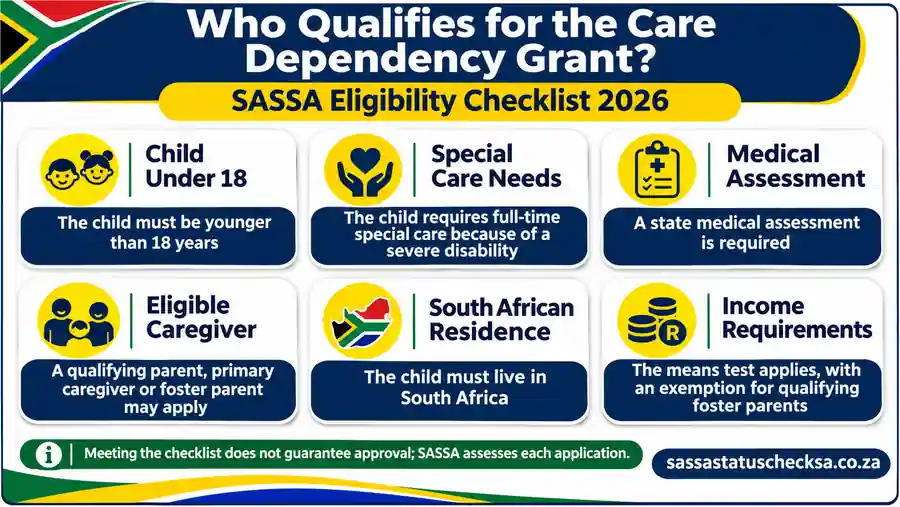
To qualify for the SASSA Care Dependency Grant, a caregiver needs more than proof that a child has a disability. SASSA checks who cares for the child, the child’s age and living arrangements, the need for full-time special care, and the required medical assessment. Most parents and primary caregivers must also meet the relevant income test. A court-appointed foster parent has a specific income-test exception, but the child’s care needs still have to qualify.
The following eligibility requirements apply to families across South Africa. Use them to prepare for a proper assessment, not to decide on your own that a grant will definitely be paid. SASSA must consider the documents and circumstances of the individual child and caregiver.
Child’s Age and Full-Time Special Care Requirements
The Care Dependency Grant covers eligible children from birth until they turn 18. A child who is 17 may still be assessed if the other conditions are met; a child who has turned 18 no longer meets this grant’s age requirement. At that stage, an application for a different benefit, such as a Disability Grant, may need to be considered under separate rules. The Care Dependency Grant does not automatically convert into an adult grant.
The child must have a severe physical or mental disability and need full-time and special care. For some families, that means extensive help with feeding, mobility, communication, hygiene or staying safe; for others, the support needs may involve supervision and complex daily routines. These are illustrations, not an official checklist of approved diagnoses or a promise that a particular condition qualifies.
In practice, the assessment focuses on the child’s actual disability-related support needs. A diagnosis, a school placement or a hospital letter can help explain those needs, but none replaces the required medical or functional assessment through SASSA’s process. The medical-assessment section later in this guide explains how that assessment works and which clinical records can help.
Caregiver Citizenship, Refugee Status and South African Residence
Under SASSA’s published grant requirements, a qualifying applicant may be a South African citizen, permanent resident or recognised refugee. Both the applicant and the child must live in South Africa. Being responsible for a child while living outside the country does not automatically meet the residence condition, and an applicant should not assume that caring for a South African child removes the need to prove the caregiver’s own eligible status.
Prepare the identification or immigration-status documents relevant to your circumstances and be ready to explain where the child normally lives. If you are a refugee or permanent resident, confirm with SASSA which current permits and identification documents it accepts. A missing or unusual document should be discussed with SASSA rather than replaced with an invented ID number or a third-party form.
The child’s situation matters separately from the adult’s status. A caregiver may meet the residence rule but still need to show the child’s age, the actual care arrangement and the medical requirement. Those checks are part of the complete eligibility decision, not additional fees or optional paperwork.
Parent, Primary Caregiver and Court-Appointed Foster Parent Rules
There are three broad applicant categories: a parent, a person who is genuinely acting as the child’s primary caregiver, or a foster parent whose placement is recognised by a court order. A biological relationship is not the only route. For example, a grandparent who actually provides primary care may be able to apply, but SASSA can ask for evidence of that caregiving arrangement rather than relying only on the family relationship.
A court-appointed foster parent should keep the current foster-care court order available. For a caregiver who is not the parent, SASSA may ask for a sworn statement, social-worker information, a school letter or other supporting proof that the child is in that person’s care. The exact document requirements belong to the application and documents sections later in this guide.
There is an important difference between being a foster parent in everyday language and having a legally recognised foster placement. SASSA’s foster-parent income exemption is associated with the qualifying foster arrangement, not simply with looking after someone else’s child. SASSA also states that an eligible foster parent can apply for both a Foster Child Grant and a Care Dependency Grant for the same care-dependent child; neither grant is automatic merely because the other is paid.
State Institutions, School Attendance and Common Misunderstandings
The child must not be permanently cared for in a state institution. A full-time institutional placement can change the basis on which a caregiver qualifies, because the grant is intended to help provide the child’s ongoing special care. If the child receives residential treatment or has been admitted to a state-funded care facility, tell SASSA exactly what kind of placement it is and how long it is expected to last.
This condition should not be confused with ordinary school attendance, a special-needs school, a clinic visit or occasional treatment. Those circumstances do not by themselves establish that the child is permanently maintained in a state institution. It is the real living and care arrangement that SASSA must assess. Do not withhold information about residential care because you fear an automatic refusal.
Likewise, a child’s need for disability-related support does not mean the caregiver must stop working entirely. Employment income can matter to a non-foster applicant through the means test, but the fact that an adult has a job is not, by itself, the complete eligibility decision. The next section explains how to compare income correctly.
Quick eligibility self-check
Before contacting SASSA, check the following points. The list is for preparation and does not replace an official grant decision.
- The child is younger than 18.
- The child has severe disability-related support needs requiring full-time special care.
- You are a parent, proven primary caregiver or qualifying court-appointed foster parent.
- You and the child live in South Africa, and you have an eligible citizenship or residence status.
- The child is not permanently cared for in a state institution.
- A state medical or functional assessment can confirm the qualifying needs, and the applicable means-test rules can be satisfied.
Keep your own notes on anything uncertain and ask SASSA about it. Later sections explain the medical assessment and the documents to prepare before applying.
Care Dependency Grant Means Test 2026/27: Income Limits
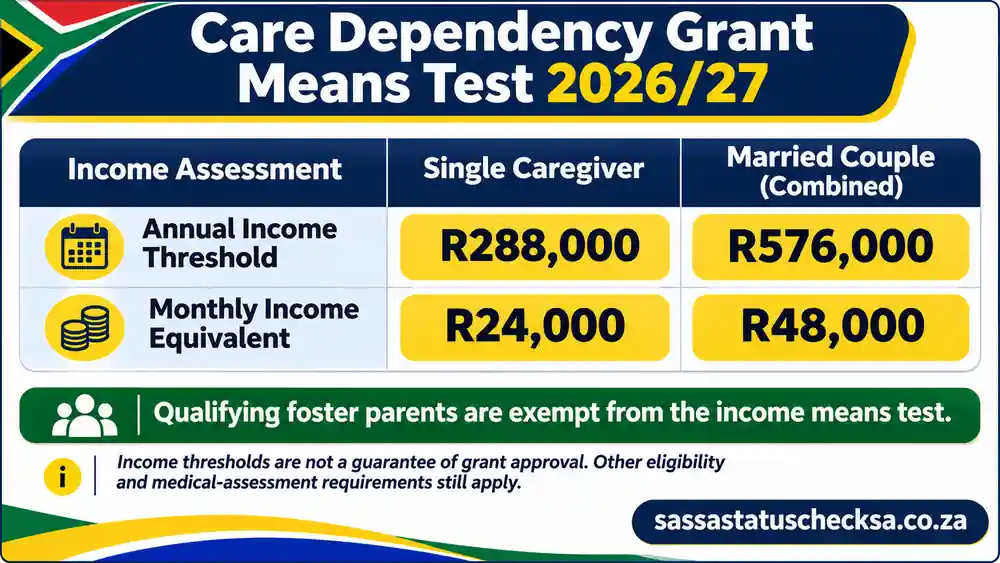
The Care Dependency Grant means test checks whether a parent or primary caregiver falls within the relevant income limits. It is not the same income test used for the SRD R370 grant or for an older person’s pension. For 2026/27, South Africa’s National Treasury sets the Care Dependency income ceiling at R288,000 a year for a single caregiver and R576,000 a year for a married couple’s combined income. Foster-parent income is treated differently under SASSA’s published exception.
These are eligibility thresholds, not the amount the caregiver receives. The grant itself is R2,400 per month for an approved child, as explained in the earlier section. Families should compare their income against the correct caregiver category without assuming that passing the income check guarantees a positive medical assessment or an approved application.
Single and Married Income Limits for 2026/27
The annual figures are the most important reference. Dividing them by 12 gives convenient monthly equivalents of R24,000 for a single caregiver and R48,000 in combined monthly income for a married couple. These monthly amounts are simple equivalents for understanding the limits; they are not permission to omit variable or irregular income from the actual assessment.
| Caregiver category | Annual income limit | Monthly equivalent |
|---|---|---|
| Single parent or primary caregiver | R288,000 | R24,000 |
| Married parents or primary caregiver and spouse (combined) | R576,000 | R48,000 |
| Qualifying court-appointed foster parent | Foster-parent income is not counted for this grant | No caregiver-income threshold under this exception |
The R288,000/R576,000 annual thresholds are from National Treasury’s 2026 Estimates of National Expenditure; the monthly equivalents are those amounts divided by 12. The foster-parent exception comes from SASSA’s Care Dependency requirements and the grant regulations. SASSA determines which income is assessable and whether all other conditions are met.
When married, the relevant limit is based on the combined qualifying income of the caregiver and spouse, not R576,000 for each person. A family with one working spouse and one caregiver at home cannot ignore the working spouse’s income. Equally, one month with unusually high or low earnings should not be used as a substitute for accurate financial records.
Why some 2026 websites show different limits
Some older government information pages and unofficial articles still display R223,200 for single caregivers and R446,400 for married couples. Those are older figures. For this 2026/27 guide, use the more recent R288,000 / R576,000 thresholds from the 2026 National Treasury budget documentation. SASSA makes the final determination using the rules in force for your application.
Which Income Counts, and Why Are Foster Parents Different?
For a non-foster applicant, income is not limited to a salary. Depending on the relevant rules and declarations, SASSA may ask about wages, self-employment earnings, pension income or other regular financial resources, along with information about a spouse where applicable. Bring truthful and complete records rather than comparing only the amount deposited into one bank account last month.
The published Care Dependency threshold is an income test. It should not be confused with the separate asset ceilings used for certain adult social grants. However, that does not mean you can ignore questions about the family’s financial circumstances or supporting evidence requested by SASSA. The grant decision must still satisfy the applicable regulations and evidence requirements.
A qualifying foster parent is different: SASSA states that the foster parent’s income is not taken into consideration for the Care Dependency Grant. This exception does not waive the age, residency, state-institution or medical requirements for the child. A caregiver should be ready to show the court order or other proof establishing that the placement is formally recognised.
If the child has their own income or unusual financial circumstances, disclose the information when SASSA asks. The applicable regulations also include provisions relating to income received by the child, so it would be misleading to suggest that every other financial factor is automatically irrelevant once the caregiver passes the headline limit.
Simple Income-Test Examples for Different Families
These examples show how to compare a family’s declared income with the 2026/27 ceiling. They do not assess the child’s disability, provide an official income calculation or guarantee payment. SASSA may require specific documents, deductions or clarification before reaching a decision.
| Family situation | Income comparison | What it tells you |
|---|---|---|
| Single caregiver earning R16,000 per month | R192,000 per year is below R288,000. | The headline income limit may be met; SASSA must still assess the child’s care needs and other conditions. |
| Married caregiver and spouse with combined income of R50,000 per month | R600,000 per year exceeds R576,000. | The stated combined income is above the headline threshold; an official assessment of applicable income rules is still required. |
| Court-appointed foster parent with earnings above the single-caregiver limit | Foster-parent income is excluded under the specific exception. | High foster-parent earnings alone do not end the enquiry; the court placement and child’s eligibility still need verification. |
Example totals use simplified regular earnings multiplied by 12. Real means-test decisions may involve other evidence and rules; these examples should not be used as grant-status results or payment forecasts.
If you are close to the threshold or your income changes during the year, prepare recent payslips, income statements and relevant spouse records. SASSA can tell you which records apply and how the current means test is applied to your circumstances. Do not pay an agent to guarantee eligibility or enter income records on a third-party form claiming to be the SASSA application portal.
The next sections explain the required state medical assessment and the documents to gather before applying. These are necessary steps even when a parent or caregiver appears to satisfy the income test.
How Does the Care Dependency Grant Medical Assessment Work?
The Care Dependency Grant medical assessment is a key part of deciding whether a child qualifies for assistance. SASSA requires a medical or assessment report confirming a severe disability and the need for full-time and special care. The assessment is not simply a check that a child has a diagnosis: it considers the support the child needs in daily life. The medical requirement applies even where the caregiver meets the income test or qualifies for the foster-parent income exception.
Families often already have clinic letters, hospital records or reports from specialists. Those records can be useful, but a private diagnosis or a school document on its own does not replace the state assessment required through SASSA’s process. Ask the relevant SASSA office which referral and prescribed report arrangements are currently used before arranging an assessment independently.
State Medical Officer Referral and Assessment Process
South African government guidance says that SASSA refers the child for assessment by a state medical officer as part of the Care Dependency Grant application procedure. The officer assesses the child’s disability and the need for ongoing special care, and the resulting medical or assessment report forms part of the eligibility evidence. This is why a family should contact SASSA about the referral process instead of assuming an ordinary doctor’s letter alone will complete the requirement.
At the first SASSA enquiry, explain that you want to apply for the Care Dependency Grant and ask where the child should be assessed, what referral or assessment form is required and which documents to bring. The practical order of appointments and submissions may vary by service point. SASSA’s own instructions for the case take priority over a third-party website’s description of an appointment system.
If the child has mobility, transport or communication difficulties, tell the office when asking for the referral. Request information about an appropriate accessible appointment or other officially supported arrangements. Do not assume that a home visit, online assessment or urgent appointment is automatically available; SASSA must confirm the options for the individual case.
The referral matters
Existing medical records may support your case, but the required assessment must follow SASSA’s recognised procedure. Keep any referral, appointment instructions and assessment reference provided to you. Do not pay an unofficial agent who promises that a purchased report will guarantee approval.
Medical, Hospital and School Support Records to Prepare
Before attending the assessment, collect the documents you already have that describe the child’s condition and day-to-day support needs. Helpful examples can include a hospital discharge summary, specialist letter, clinic record, treatment history, therapy report, rehabilitation note or a report from a school or care professional familiar with the child. These are supporting records, not a fixed list of mandatory documents for every child.
Choose records that clearly identify the child and describe the support needed rather than bringing unrelated paperwork simply because it contains a medical term. Where a report mentions medication, feeding support, mobility equipment, supervision, communication needs or assistance with self-care, it can help the assessor understand the child’s daily circumstances. Never alter a report, invent a diagnosis or ask a professional to describe care needs that are not accurate.
For a younger child who has never attended school, a school report is not automatically required. A child who receives outpatient therapy may have useful clinical records without a recent hospital admission. If you do not have a particular type of record, explain what evidence is available and ask SASSA or the assessing service what else it needs.
What Full-Time Special Care Means During Assessment
The central question is whether the child’s severe physical or mental disability creates a need for ongoing full-time and special care. The assessment can consider practical assistance with eating, dressing, toileting, movement, communication, behavioural safety or other essential activities. The examples depend on the child’s age and condition; they are not an official point-scoring checklist or a guarantee that particular symptoms lead to a grant.
Explain the child’s needs as they are on ordinary days, including help required at home and the consequences if that help is unavailable. Describe support given by caregivers, family members, therapists or school staff accurately. If the child’s needs fluctuate, tell the assessor rather than describing only the easiest or most difficult day. The decision depends on the assessment and the relevant SASSA criteria, not on using a particular phrase.
A disability diagnosis, special-needs school placement, therapy schedule or mobility aid does not automatically establish eligibility. Equally, a child who attends school or receives treatment should not be assumed ineligible solely for that reason. The distinction between a child needing full-time special care and a child being permanently cared for in a state institution remains important, as explained in the eligibility section.
What if the Medical Report Is Missing or the Decision Is Unclear?
If you have not received the prescribed medical or assessment report, contact the SASSA office handling the application and ask whether the referral has been issued, whether an appointment or result is outstanding, and how the document should reach SASSA. Keep a note of the date, office and reference. Do not treat an unanswered referral as a rejection, and do not submit a copied report from another child’s application.
If the medical findings do not appear to reflect the child’s current needs, ask SASSA which official clarification or reconsideration steps are available and whether newer clinical evidence can be considered. There is no single guaranteed second-assessment route for every situation. A formal refusal, once issued, has a separate challenge process; the article’s later approval-and-appeals section explains how to respond to written reasons without using the unrelated SRD R370 appeal portal.
Keep medical information private. Give reports and identity documents only to SASSA or the authorised assessment service through the instructions provided to you. This independent information website does not perform disability assessments, collect medical files or decide eligibility.
Documents Needed for a Care Dependency Grant Application
Preparing the Care Dependency Grant application documents early can reduce repeat visits and delays. SASSA needs evidence of the child’s identity and age, the applicant’s identity and caregiving authority, the medical assessment, and any financial information required for the income test. Which additional records apply depends on whether you are the child’s parent, primary caregiver or court-appointed foster parent.
Take the original documents you have and clear copies where possible, then follow the office’s current requirements for originals, certified copies or prescribed forms. This is a preparation checklist, not a promise that the same pack will be sufficient in every case. SASSA can request other evidence to resolve a discrepancy.
Caregiver ID, Child’s Birth Certificate and Residence Evidence
Bring an accepted identity document for the caregiver and the child’s valid birth certificate or identity document, as applicable. Where a spouse’s information is needed, be ready to supply that person’s identification too. Permanent residents and recognised refugees should ask SASSA about the specific current documents proving their status. Both the applicant and the child must live in South Africa, so be prepared to show or explain the child’s actual residential arrangements.
SASSA may ask for proof of address or another record confirming residence in a particular case. An applicant living with family members may not have a utility account in their own name; that is a reason to ask which alternative proof or declaration the office accepts, not a reason to invent an address. Make sure names, birth dates and identification numbers are consistent across the records you bring.
When the caregiver and child’s surnames differ, explain the relationship accurately and bring relevant supporting records. A surname difference alone does not establish that a person is ineligible, but SASSA may need evidence that the applicant has the proper caregiving role.
Income Records, Bank Statements and Marital Status
Parents and primary caregivers who are subject to the income test should prepare payslips, pension or other income statements and bank statements for the previous three months, as relevant. If you are married, SASSA may also require your spouse’s qualifying income information. The 2026/27 annual thresholds in the previous section are R288,000 for a single caregiver and R576,000 combined for a married couple; these are not thresholds for the unrelated SRD R370 grant.
Bring proof of marital status when relevant, such as a marriage certificate, divorce order, death certificate or another form of evidence SASSA accepts. If you have no current employment income, explain your circumstances truthfully. A UIF record or former employer discharge certificate may be relevant where applicable, but an applicant who never worked for an employer should not manufacture one.
A court-appointed foster parent benefits from the specific foster-parent income-test exception. That does not remove the need to establish the foster placement, the child’s identity, medical eligibility and any records SASSA requests to verify the application. Ask the official which financial statements or declarations are appropriate rather than assuming that every item in a general parent checklist applies identically.
Foster Court Orders, Primary-Caregiver Proof and Special Cases
If you are a legally appointed foster parent, bring the current children’s court order placing the child in your care, plus the relevant identity or refugee-status documentation. An informal arrangement to look after a child is not the same as court-appointed foster care for the income-test exemption. If the legal placement has changed or expired, ask the responsible authority which valid evidence is needed.
If you are the primary caregiver but not the child’s parent, SASSA may accept or request supporting evidence such as a social worker’s report, an affidavit from the biological parent, a statement from a police official or a letter from the child’s school principal. Choose evidence that accurately reflects your role and follow the form or verification instructions given by SASSA.
Where a biological parent is the sole provider, government guidance also mentions proof of efforts to obtain maintenance from the other parent. This is relevant to that particular family situation, not a universal document that every applicant must supply. If the caregiver is too ill or otherwise unable to visit a SASSA office, ask about an authorised representative and the letter or doctor’s note SASSA may require; the application procedure itself is explained in the application section below.
Missing ID or Birth Certificate: What to Ask SASSA
A missing identity document or birth certificate should be raised with SASSA as early as possible. Government guidance describes an alternative evidence procedure in some cases, which can include a SASSA-prescribed affidavit made before a Commissioner of Oaths who is not a SASSA official, a supporting sworn statement from an appropriate community representative, and proof that an ID or birth certificate has been requested from the Department of Home Affairs.
Depending on the case, SASSA may take the applicant’s fingerprints, request a Home Affairs temporary ID, or consider a road-to-health card, school report or similar supporting document. These are possible elements of an official alternative-verification process, not automatic substitutes that can be selected from a third-party checklist. Missing identity documents can also require continued Home Affairs follow-up after the grant application has started.
Do not upload your child’s ID, birth certificate, bank statements or medical reports to an unofficial grant website. If a particular form or sworn statement is needed, obtain the current approved instructions from SASSA and keep copies of what you submit.
| Document or evidence | Who may need it | Preparation tip |
|---|---|---|
| Caregiver ID or qualifying status record | Every applicant | Bring the accepted original or ask SASSA about current alternatives. |
| Child’s birth certificate or identity document | Every application for a child | Check the name and date of birth; discuss missing records with SASSA. |
| State medical/assessment report | Every qualifying child | Follow SASSA’s referral and prescribed assessment procedure. |
| Existing clinic, specialist or therapy records | Where available and relevant | Use them to explain care needs; they do not replace the required assessment. |
| Income proof and three months of bank statements | Applicants subject to the income test, as requested | Include spouse information where relevant; foster-parent exception applies. |
| Marriage, divorce or spouse-death evidence | When applicable | Bring records matching the marital status you declare. |
| Children’s court foster-care order | Court-appointed foster parents | Bring the placement order and current status or identity documents. |
| Primary-caregiver or maintenance evidence | Non-parent caregiver or sole-provider parent, where relevant | Ask which affidavit, social-worker report or other proof SASSA accepts. |
| Home Affairs receipt, prescribed affidavit or alternative ID proof | When standard ID or birth certificate is missing | Follow SASSA’s exact alternative-verification directions. |
This table combines South African government and SASSA application guidance with the applicable document regulations. Individual case requirements can differ; a SASSA official decides which specific records and prescribed forms are needed.
One folder before your SASSA visit
Place the child’s identity record, your ID or qualifying status proof, relevant medical records, income evidence, marital or caregiving documents and any correspondence about the state assessment together. Keep copies of official referrals and receipts. The next section explains how the application and receipt process works; gathering documents does not mean a grant has already been submitted or approved.
How to Apply for the SASSA Care Dependency Grant
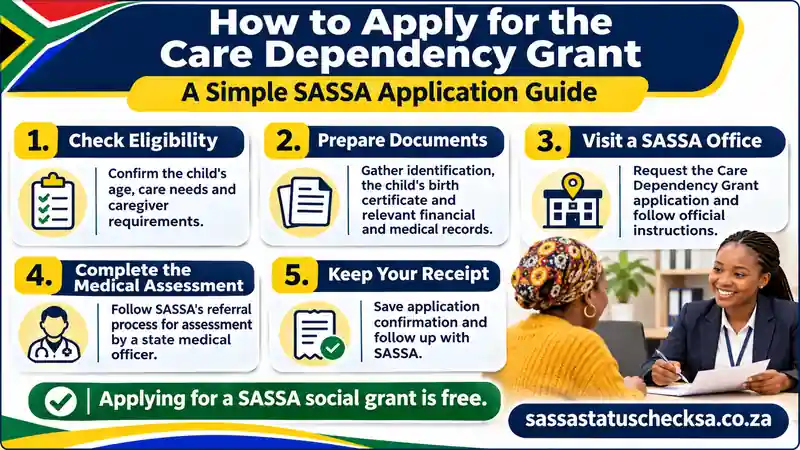
To apply for the SASSA Care Dependency Grant, start with SASSA’s recognised application route and the medical assessment described earlier in this guide. The South African government’s published instructions direct caregivers to a SASSA office, explain that SASSA refers the child for a state medical officer’s assessment, and require the grant application form to be completed through the official procedure. The application itself is free; do not pay a person who promises faster approval.
Being prepared reduces avoidable return visits, but it does not guarantee a favourable decision. Your child must meet the severe-disability and full-time special-care requirements, while the applicant must meet the relevant caregiver, residence and, unless an exception applies, income-test rules. If you are unsure which documents your circumstances require, confirm them with SASSA before travelling.
Step-by-Step Care Dependency Grant Application at a SASSA Office
These steps combine the official sequence into a practical preparation guide. SASSA may organise the referral, assessment and office appointments differently at individual service points, so follow the instructions given for your case rather than relying on a fixed appointment schedule published by a third party.
- Contact the nearest SASSA service point. Ask how to begin a Care Dependency Grant application, where the child must be assessed and whether you need an appointment. You can call SASSA’s published toll-free line, 0800 60 10 11, to enquire about the current office arrangements.
- Arrange the recognised medical assessment. Follow SASSA’s referral process for assessment by a state medical officer. Bring any existing medical, clinic, therapy or school-support records that help describe the child’s actual care needs, without treating them as a replacement for the required assessment report.
- Gather the documents that apply to you. Prepare the child’s birth certificate or permitted alternative, your accepted identity/status evidence, caregiving proof, relevant income and bank statements, and marital records where required. Court-appointed foster parents should prepare the placement order. Use the detailed document checklist in the preceding section.
- Complete the official application process. Attend the SASSA office or follow a specifically confirmed SASSA arrangement. The government’s published procedure says that the form is completed in the presence of a SASSA official and by the applicant or an authorised SASSA official. Answer questions accurately and ask for clarification before signing a declaration you do not understand.
- Request and keep your receipt. Store the dated proof of application and any reference or case number issued by SASSA. Check that your contact details are correct so the agency can reach you if further evidence or verification is needed.
When giving financial information, declare your actual circumstances. Parents and most primary caregivers should provide the relevant income evidence, including a spouse’s information where required; court-appointed foster parents are exempt from the income means test, but must still establish the qualifying care arrangement and the child’s medical eligibility. Do not confuse that exception with an automatic grant approval.
The medical referral comes before a completed application
Government guidance explicitly places the state medical officer’s assessment referral before the formal Care Dependency Grant application. A private diagnosis or the fact that you visited a SASSA office does not mean an application has been completed. Ask SASSA which stage your case has reached and keep proof of each completed step.
Documents, Declarations and Help From a SASSA Official
SASSA may need to verify who is legally or practically responsible for the child. A biological parent, a grandparent acting as primary caregiver and a court-appointed foster parent may need different supporting documents. Be ready to explain the child’s ordinary living arrangements and the daily special care provided, without exaggerating a disability or hiding relevant information.
If a required identity document or birth certificate is missing, tell SASSA before attempting to complete the form. The official process may provide for prescribed affidavits, Department of Home Affairs follow-up and other identity checks. Those alternatives are case-dependent; they are not a reason to submit a made-up ID, a different child’s document or an unofficial scanned form.
Where the child has already been seen by medical specialists, supply authentic records that you actually possess. SASSA’s assessment and the completed official application, not the number of reports collected, determine whether a case can proceed. The prior medical and documents sections explain these requirements in greater detail.
Keep the Application Receipt and Avoid Unofficial Fees
After completing the application, SASSA provides a receipt to serve as proof that you applied. Keep the original safely, make a copy or note the reference, and record the day you submitted the application. A receipt proves submission; it does not prove that the grant has been approved or that payment has been released.
There is no official fee to apply for this grant. Be cautious of anyone demanding payment for a supposed approval slot, a guaranteed medical result, a quicker first payment or release of an existing grant. Do not give banking PINs, one-time passwords, children’s medical reports or identity images to strangers or to this independent information website.
Before leaving a service point, ask whether anything remains outstanding and how you will be informed about the decision. If SASSA requests further information later, verify the request through an authorised office or contact channel and keep proof of what you supplied.
Can You Apply Online or Have Someone Apply on Your Behalf?
SASSA operates a services portal that lists grant information and registration services. However, the South African government’s Care Dependency Grant service page says its application form is not available online and directs applicants to a SASSA office. Do not assume that an online profile or a general grant-information screen is a working Care Dependency Grant submission service. If SASSA introduces or confirms a specific online application route, follow only its current official instructions.
If the caregiver is too ill or unable to travel, government guidance describes cases in which a family member or friend can attend on the caregiver’s behalf with supporting written authorisation or a medical note. This is not permission for a helper to submit false declarations or freely use someone else’s identity or banking credentials. Ask the SASSA office which arrangement, signed letter and identity documents are accepted for your particular case, especially because the formal application must follow the prescribed applicant/officer process.
Finally, do not use an SRD R370 application website to submit a Care Dependency Grant claim. SRD is a separate programme with separate rules. Confirm the correct grant name whenever you contact SASSA, particularly when more than one person in the household receives social assistance.
Care Dependency Grant Application Status, Approval and Appeals
After submitting a Care Dependency Grant application, a caregiver may be waiting for the medical assessment to be accepted, outstanding documents to be checked or SASSA to issue a decision. These are different stages, and an unanswered enquiry is not necessarily a refusal. Keep your dated receipt and the information SASSA gave you; they are the best starting points for a useful follow-up.
The South African government’s published processing guidance is up to three months. This is a general administrative timeframe, not a promise of approval within a fixed number of days or of payment on a specific month’s grant date. If your case requires further verification, ask SASSA what is outstanding rather than submitting another application without advice.
How Long Does Approval Take, and How Do You Check Your Application?
Allow for the official assessment process to run, but keep a record of the date on your application receipt. If you need an update, contact the SASSA office handling the application or ask the toll-free enquiry service on 0800 60 10 11 how to confirm the status of a regular Care Dependency Grant application. Have your receipt or reference ready and explain that the application concerns a child needing full-time special care.
Ask a specific question: Has the medical assessment been received? Is identification or income verification outstanding? Has a formal approval or refusal decision been recorded? What is the recognised next step for this case? These questions are more useful than relying on a generic message saying a grant is ‘pending’. SASSA may need to authenticate a caller before discussing a personal record.
A separate online SRD status check cannot reliably tell you whether this regular child-care grant has been approved. Nor should an unfamiliar website that requests a child’s ID number, medical information or an OTP be treated as a verified SASSA application-status service.
| Stage or response | What to confirm | Practical next step |
|---|---|---|
| Assessment not complete | Has SASSA arranged the required state medical assessment? | Follow the official referral instructions and keep appointment evidence. |
| Additional documents requested | Which exact identity, care, medical or financial records are missing? | Provide the specified documents through an authorised channel and keep a receipt. |
| Application under consideration | Has SASSA received the completed application and recorded a reference? | Follow up with that reference; do not assume approval from silence. |
| Approved, first payment not received | What effective date, payment method and verification steps are recorded? | Ask SASSA when the first payment is expected to become available. |
| Refusal communicated | What are the written reasons and date of notification? | Read the prescribed appeal instructions promptly; note the 90-day window. |
These are explanatory follow-up categories, not a quotation of SASSA’s internal application-status codes. Only SASSA can confirm the stage or decision on an individual record.
If the Grant Is Approved, When Will the First Payment Arrive?
An approval means SASSA has accepted the application under the applicable eligibility rules; it does not necessarily mean that the first deposit appears on the same day. Government grant guidance describes payment entitlement from the application date for approved cases. This can result in amounts due for an earlier eligible period being included when the first payment is arranged, subject to SASSA’s determination of the actual recorded date, entitlement and payment processing.
For example, if a caregiver applies in one month and SASSA approves the grant later, the effective date may be earlier than the day the decision letter arrives. That does not mean the caregiver should simply multiply R2,400 by the number of calendar months and expect that exact amount without an official assessment. SASSA must confirm the dates and any amount payable for that case.
After approval, check that SASSA has the intended payment method and correct beneficiary information. A bank-account verification issue, an incorrect recorded detail and a grant that has not yet been approved are three different problems. The next section of this article will explain the monthly payment calendar and payment methods; it will not invent a guaranteed first-payday date.
An approval date is not a payday
The receipt date, effective entitlement date, decision date and first payment date can differ. Request clarification from SASSA if your approval notice or first payment does not match what you expected.
If the Care Dependency Grant Is Declined: Reasons and the 90-Day Appeal
If SASSA refuses a Care Dependency Grant application, government guidance says the applicant should be informed in writing of the reasons. The explanation matters. A medical eligibility decision, insufficient proof of caregiving, missing identification and a financial means-test result are not the same issue; each may require different evidence or clarification.
Where the applicant disagrees with an unsuccessful decision, the published procedure provides for an appeal to the Minister of Social Development through the national Department of Social Development, generally within 90 days of being notified of the refusal. Follow the actual refusal letter and obtain the currently accepted appeal procedure from SASSA or the Department of Social Development. Do not assume an old form, address or online tool remains valid.
Retain the refusal notice, application receipt, relevant medical or assessment records, caregiver identity or court documents, and any evidence correcting the reason for refusal. If the decision mentions a medical assessment, ask the agency how that finding can properly be challenged; do not seek a fraudulent replacement report. The appropriate outcome is decided through the official appeal process, not by an information site or a person offering a paid guarantee.
Do Not Confuse an SRD R370 Appeal or Status Portal With This Grant
The Care Dependency Grant is a regular social grant supporting an eligible child with severe disability-related care needs. The SRD R370 grant is a different social assistance programme, with its own monthly status decisions and appeals procedure. A monthly SRD decline reason or an SRD appeal submission is not a decision about your child’s Care Dependency Grant.
If you have received a formal Care Dependency Grant refusal, identify the appeal route shown on that regular-grant notice and confirm it with SASSA or the Department of Social Development. Avoid copying the instructions for SRD monthly appeals, which may lead you to the wrong system and risk missing the correct deadline.
What to do next: Keep the receipt and all correspondence together, follow up through SASSA when a decision or document is outstanding, and act promptly on any written refusal. If approval has been granted, confirm the payment method rather than assuming the SRD monthly status website will show your Care Dependency Grant payment. The next section covers recurring payments, reviews and changes in eligibility.
Care Dependency Grant Payment Dates, Reviews and Common Questions
Once a Care Dependency Grant has been approved, the caregiver needs to know when payments are scheduled, how to access the money safely and what to do if SASSA asks for a review. The R2,400 monthly amount in 2026 is not itself a payment date. The calendar, the beneficiary’s grant record and the chosen payment method all matter.
This section covers the remaining 2026/27 payment calendar, common review and suspension problems, and what changes when the child turns 18. Families who are still applying should use their application receipt and the official approval procedure explained in the preceding section; an ordinary payment date does not mean an unfinished application has been approved.
Care Dependency Grant Payment Dates for November 2026 to March 2027
SASSA publishes its regular annual grant calendar in three broad categories: Older Persons, Disability and Children’s Grants. The agency has previously grouped the Care Dependency Grant with child-related grants such as Child Support and Foster Child grants for payment scheduling. Its 2026/27 main calendar does not list a separate Care Dependency row, so the Children’s Grants dates are the relevant published category reference rather than an individual payment guarantee.
November 2026 is an exception. SASSA changed the originally published Children’s Grants date from Thursday, 5 November to Tuesday, 3 November 2026, ahead of the 4 November local government elections. Thursday, 5 November was separately set aside for affected review cases; it is not a second general Children’s Grants payday. SASSA said the later months remain on the approved regular schedule.
| Grant month | Published date | Important context |
|---|---|---|
| November 2026 | Tuesday, 3 November 2026 | Revised date; replaces the original 5 November entry |
| December 2026 | Friday, 4 December 2026 | Regular approved calendar |
| January 2027 | Thursday, 7 January 2027 | Regular approved calendar |
| February 2027 | Thursday, 4 February 2027 | Regular approved calendar |
| March 2027 | Thursday, 4 March 2027 | Regular approved calendar |
This table reproduces the official Children’s Grants category dates and the confirmed November revision, not an individually verified Care Dependency account release. The actual credit or cash-access arrangement may differ for an individual, particularly when other grants are linked to a card/account or an administrative review is involved.
For the complete April 2026–March 2027 calendar, other grant categories and later official changes, see our SASSA payment dates guide. If your Care Dependency payment does not appear when expected, check the beneficiary’s grant record with SASSA rather than relying on an unofficial generic SRD status form.
How Care Dependency Payments Are Made and Collected Safely
The government describes payment through an electronic deposit into an approved bank or Postbank account, a designated cash-collection arrangement where available, or an authorised institution administering a grant. The method on the beneficiary’s SASSA record is more important than advice that assumes every caregiver uses one particular card. Ordinary bank or account charges may apply depending on the arrangement.
A caregiver who cannot collect personally should ask SASSA about an officially accepted procurator or power-of-attorney arrangement. Being a friend or relative does not by itself authorise someone to take a beneficiary’s card, use a PIN or change bank details. Keep card PINs, one-time passwords, children’s identity documents and medical records out of messages to strangers.
When the expected money is missing, check whether the grant has been approved and is still active, whether the published payment cycle has arrived, and whether the bank/card or collection arrangement is functioning. If it is unclear whether the problem is a SASSA review, a release delay or banking access, contact the agency with your grant reference and ask for the recorded reason. Do not submit a new grant application simply because an ATM shows no funds.
A payment date is not an instruction to queue
For an accessible approved bank-account payment, funds generally remain available after deposit. Families do not need to treat the first scheduled day as the only possible withdrawal day. Confirm current collection arrangements directly with SASSA if your payment route is unusual or affected by an official notice.
Reviews, Suspensions and When a Care Dependency Grant Can Lapse
SASSA can review a Care Dependency award when a caregiver’s financial circumstances or the child’s eligibility appear to have changed. A review can involve income records, the care arrangement, residence, identity verification or medical evidence. The agency may require an updated medical or functional assessment if there is a reasonable basis to believe the child’s condition no longer satisfies the grant rules. A review notice is not automatically a finding of fraud or a permanent cancellation.
If SASSA sends an official review or life-certification notice, read the stated deadline and the documents requested. The government information page describes advance notification arrangements and life certificates in certain payment situations, while SASSA has also introduced newer identity-verification processes. Follow the specific current instruction in your notice instead of assuming every caregiver must follow one identical in-person or online procedure. If travel is difficult, ask SASSA whether a recognised representative or assisted process is available.
A grant may be suspended when relevant circumstances change, an official review is not completed, false information was supplied, or SASSA identifies an error in the original approval. Lapsing is different: the official Care Dependency guidance identifies events including the child’s death, the child turning 18, the child’s permanent admission to a state institution, qualifying absence from South Africa or a grant not being claimed for three consecutive months. The exact recorded status determines the appropriate remedy.
Do not assume that a few days’ delay means a grant has lapsed, or that every care institution is treated identically. Ask SASSA for the actual reason and the available review, correction or appeal process. If you receive a letter, keep a copy and note its date, because any time limit should be calculated from the relevant decision and instructions, not guessed from a social-media post.
| Situation | What it may mean | What to do |
|---|---|---|
| No money on expected date | Payment channel, approval or release issue | Check the active grant record and the recorded payment method |
| Review notice received | Eligibility or identity information needs checking | Follow the official notice and supply the requested evidence on time |
| Grant suspended | Payment interrupted after a review or qualifying concern | Request the reason and ask about correction or review |
| Grant lapsed | Entitlement ended under an applicable rule | Ask SASSA which restoration, challenge or fresh-application route applies |
These are general administrative distinctions. Only SASSA can confirm a beneficiary’s individual record or whether payment should restart.
What Happens to the Care Dependency Grant When the Child Turns 18?
The Care Dependency Grant is for a qualifying child younger than 18. Government guidance lists the child’s 18th birthday as a reason this grant lapses. The existing caregiver grant does not automatically continue indefinitely, and it does not simply change its name to an adult grant.
If the young person is approaching 18 and will still have a disability that substantially affects their ability to work, ask SASSA early about the separate Disability Grant eligibility and application process. That adult grant has its own age, medical assessment and means-test rules and requires an independent decision. The 2026 Care Dependency amount being the same as the maximum adult Disability Grant amount does not make approval or automatic conversion certain.
Caregivers can begin gathering the young person’s identity documents, relevant medical history and income/household evidence in advance. Find out whether a new medical assessment or appointment will be needed and what SASSA expects when the person reaches the qualifying age. Do not file a duplicate adult application under the child’s name before SASSA confirms the proper procedure. Plan ahead to reduce the risk of an avoidable gap in support.
Care Dependency Grant Frequently Asked Questions
The answers below focus on the approved care-dependent child’s grant, not the separate monthly SRD R370 status process. Open a question for the explanation relevant to your situation.
How much is the Care Dependency Grant in 2026?
The published Care Dependency Grant rate is R2,400 per month from April 2026 for each eligible approved child. It is not an automatic payment to every household caring for a child with a disability; SASSA must approve the application and the child must meet the qualifying criteria.
Which payment date should a Care Dependency caregiver check?
The 2026/27 public annual schedule publishes a broad Children’s Grants category, and SASSA has grouped Care Dependency with child-related payments. For the revised November 2026 cycle the Children’s Grants date is 3 November, not the original 5 November date. Check your own SASSA payment record if the account, review or linked grant arrangement differs.
Does a diagnosis alone qualify my child for the grant?
No. The child must meet the severe-disability and full-time special-care requirements, and the official procedure includes a state medical officer’s assessment. A private doctor’s letter, school report or diagnosis can support the assessment but is not, on its own, a guarantee of approval.
Can a foster parent receive both Foster Child Grant and Care Dependency Grant?
Yes, SASSA says a qualifying, court-appointed foster parent may apply for the two grants for the same care-dependent child. Foster-parent income is exempt from the Care Dependency means test, but the child’s medical needs, age, residence and valid foster arrangement must still be established.
Can I receive a Care Dependency Grant if I work or my spouse has income?
Working does not automatically rule out eligibility. Parents and most primary caregivers must satisfy the applicable income means test, which considers the married couple’s combined qualifying income where relevant. The approved 2026/27 thresholds and the foster-parent exception are explained in the earlier means-test section.
Can the Care Dependency Grant be stopped after approval?
Yes, a grant can be reviewed, suspended or lapse for different reasons, including changes in eligibility, missed review requirements or reaching the age limit. A late payment, a temporary review and a lapsed grant should not be treated as the same event. Contact SASSA for the recorded reason before choosing a remedy.
Do I need to apply for the Care Dependency Grant again every year?
There is no universal requirement to submit a brand-new application every year while an approved grant remains valid. SASSA can, however, require reviews, identity checks, updated information or medical evidence. Respond to any official notice by its deadline and ask which process applies to your case.
What if I do not receive the payment after the published date?
First confirm that the grant is approved and active, and check the actual bank, Postbank or other authorised payment method. If there is no access to the money, contact SASSA with the reference and ask whether payment was released or held for verification. Do not share a card PIN or OTP with an unofficial intermediary.
Does Care Dependency automatically become a Disability Grant at age 18?
No. The Care Dependency Grant ends under the child-age rule, and an adult Disability Grant requires its own eligibility and medical assessment. Contact SASSA before the 18th birthday to understand the new application steps and documents rather than assuming the payment will automatically continue.
Where can I ask SASSA about an official grant review or application decision?
Contact the SASSA office handling the record or the published toll-free number 0800 60 10 11. Keep your application receipt or grant reference ready. This independent guide does not collect children’s medical records, identity details, bank information or grant applications.
Care Dependency Grant: Next Steps for Caregivers
In summary: The SASSA Care Dependency Grant offers R2,400 per month in 2026 to eligible caregivers supporting a child under 18 who needs full-time special care because of severe disability. Start by confirming the child’s qualifying medical assessment, the caregiver’s status and any applicable income test, then gather the required documents and follow SASSA’s official application process. Keep the application receipt, check the relevant grant-payment calendar only after approval and respond promptly to any review notice. If the child is approaching 18, ask SASSA about the separate adult Disability Grant process rather than expecting automatic conversion.
Confirm decisions with SASSA
Grant rules, medical findings, payment access and administrative processes can differ by individual circumstances or change over time. For a decision about a particular child’s grant, contact SASSA through its authorised channels or call 0800 60 10 11. This independent article cannot check an individual’s grant record, approve an application or receive personal documents.