
SASSA Foster Child Grant 2026: Amount, Requirements & How to Apply
The SASSA Foster Child Grant provides monthly financial support to an eligible foster parent looking after a child who has been formally placed in their care by a Children’s Court. The grant is also often called the SASSA foster care grant. From 1 October 2026, its maximum monthly rate is R1,300 for each qualifying foster child, following an earlier increase to R1,290 in April.
Having a child in your home is not, by itself, enough to claim this grant. You need the correct court placement order and must meet the other grant conditions. This guide explains the legal process, the amount, the documents to prepare, how to apply through SASSA, what happens at renewal and where to follow up if something goes wrong. It is independent information, not an application service.
Opens the South African Government’s official service information in a new tab. Only SASSA can assess and decide your grant application.
What Is the SASSA Foster Child Grant?
The Foster Child Grant helps a court-appointed foster parent meet everyday costs while a child is legally placed in their care. It is paid through the South African Social Security Agency (SASSA). A foster placement may follow circumstances such as abandonment, neglect, abuse or the death of a parent, but those circumstances are considered through a child-protection process rather than through the grant application alone.
Two public services have different roles. The Department of Social Development or an accredited child-protection organisation helps arrange the social-worker assessment and the foster-care process. The Children’s Court decides whether to place a child in foster care. Once the court order has been issued, the foster parent can apply to SASSA for the grant. Applying for foster care and applying for grant payments are therefore related but separate steps.
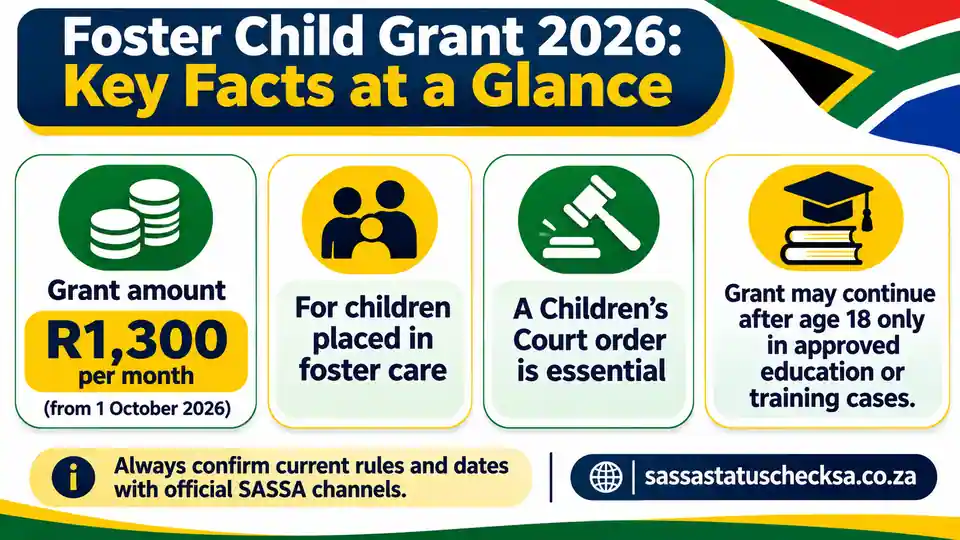
Why a Children’s Court Order Is Essential
A valid order identifies the legally appointed foster parent, the child and the duration of the placement. SASSA uses that order to check that the grant is being claimed by the person responsible for the child’s court-approved foster care. The order must remain relevant to the child’s current placement; a social-worker recommendation on its own is not the same as a final court order.
For example, a relative may have been looking after a child for several years without a formal court placement. That family situation deserves careful attention, but it does not automatically satisfy the foster-care court-order requirement for this particular grant. The family should ask a social worker or the Department of Social Development which legal care arrangement is appropriate rather than assuming that an informal arrangement can be used as proof of foster status.
Start with the right institution
If you do not have a foster-care court order yet, the first step is usually the social-work and court process, not a Foster Child Grant application at SASSA. We explain that process in the dedicated court-order section further down this guide.
Caring for a Relative vs Being an Official Foster Parent
Grandparents, aunts, uncles and other relatives sometimes raise a child whose parents cannot provide daily care. Some relatives are also legally appointed foster parents; others provide informal family care. The relationship alone does not decide grant eligibility. What matters for this grant is whether a valid court order has placed the child with that caregiver and whether the other legal and residence requirements are met.
The Children’s Court has issued a placement order naming the caregiver. The caregiver may apply for the Foster Child Grant if the remaining requirements are satisfied.
A relative looks after the child without a foster placement order. That arrangement alone does not establish eligibility for the Foster Child Grant; a different support programme or court process may be relevant.
Do not rush into a court process only because the Foster Child Grant has a larger monthly amount than some other child grants. The appropriate arrangement depends on the child’s circumstances and protection needs, and the court—not a grant information website—decides whether foster placement is warranted.
Foster Child Grant, Child Support Grant and Care Dependency Grant
All three grants support children, but they are not interchangeable. The Child Support Grant is primarily for qualifying low-income primary caregivers and generally does not require a foster-care placement order. The Foster Child Grant depends on a lawful foster placement and does not use a means test on the foster parent’s income. The Care Dependency Grant concerns a child under 18 with a severe disability requiring full-time special care, subject to its own assessment and conditions.
There is also an important exception to the assumption that a child can never qualify for two child-related grants. SASSA states that a foster parent caring for a child who also meets the separate Care Dependency Grant requirements may apply for both the Foster Child Grant and the Care Dependency Grant for that child. That does not mean automatic approval or permission to combine any two grant types; it is a specific rule for a qualifying care-dependent foster child.
For a foster child who does not have a qualifying severe disability, the Care Dependency rules do not apply simply because the child is in foster care. We cover the precise Foster Child eligibility conditions and that dual-grant exception later rather than treating a comparison as an application decision.
How Much Is the Foster Child Grant in 2026?
The Foster Child Grant amount is R1,300 per month for each approved qualifying foster child from 1 October 2026. This is the rate for November 2026 under the 2026 social-grant increase notice. Earlier in the same year, the monthly amount was R1,290, so a source published before October may still show that figure. The rate is set by government policy, not by an online calculator or a private website.
Payments are made on the relevant children’s grant schedule, provided the award remains active. The amount tells you the monthly grant rate; the payment date tells you when SASSA has scheduled the next release. Neither is a guarantee that a specific application has already been approved or that money has entered an individual bank account.
April–September 2026: R1,290 per Month
From 1 April 2026, the government increased the Foster Child Grant from R1,250 to R1,290 per month, an additional R40 for each approved child. That was the correct amount for the April-to-September 2026 period. It explains why older guides, screenshots and even some evergreen service pages still mention R1,290.
That older amount is not necessarily a sign that an entire article was false when published; it reflects a rate that changed again during the same financial year. Whenever checking historic payments or a backdated award, distinguish the month to which the payment relates from the date you happen to read the article.
From October 2026: R1,300 per Month
The 2026 Budget Speech announced a further R10 increase from 1 October 2026, bringing the Foster Child Grant to R1,300 per month. As of November 2026, this is the latest scheduled monthly rate. Do not apply the October increase to every other social grant: for example, the Care Dependency Grant does not receive the same second increase in October.
| Payment period | Monthly rate per eligible child | Change |
|---|---|---|
| Before 1 April 2026 | R1,250 | Previous rate |
| 1 April–30 September 2026 | R1,290 | Increase of R40 |
| From 1 October 2026 | R1,300 | Further R10 increase |
Why an official page may say R1,290
Some South African Government service information still displays the April 2026 amount. The dated national Budget and 2026 grant-increase notice expressly provide for a second Foster Child Grant increase to R1,300 in October. When figures differ, compare the effective date of the source rather than treating two different months as the same payment period.
Is the Foster Child Grant Paid for Each Child?
Yes. The monthly amount is attached to each child for whom a separate Foster Child Grant is approved. For illustration, if two children each have an active approved award at the October 2026 rate, the combined monthly total would be R2,600. This is a simple example, not a guarantee that every caregiver can claim for any number of children without further assessment.
There are restrictions and exceptions concerning how many foster children may be supported under a foster parent or registered care scheme. A general six-child rule and exceptions for siblings, blood relatives or specified court decisions are relevant, but the complete eligibility explanation belongs in the next section. The amount alone cannot establish whether the required court orders and circumstances qualify.
If you are applying for the first time, the next questions are usually more important than multiplying the monthly rate: do you have the correct court order, does the child continue to live in your care, and have the documents been accepted? Those checks determine whether SASSA can assess the application and from what period an award may become payable.
Who Qualifies for the Foster Child Grant?
To qualify for the SASSA Foster Child Grant, you must be caring for a child who has been legally placed with you through a valid foster-care court order. You and the child must live in South Africa, and you must satisfy the grant’s identity and residency rules. Being a relative, paying the child’s expenses or having permission from a biological parent does not replace a court order.
These are the requirements for a foster grant, not the separate requirements for an ordinary Child Support Grant. The SASSA foster care grant is specifically linked to a legally recognised placement and the child’s continuing care under that order.
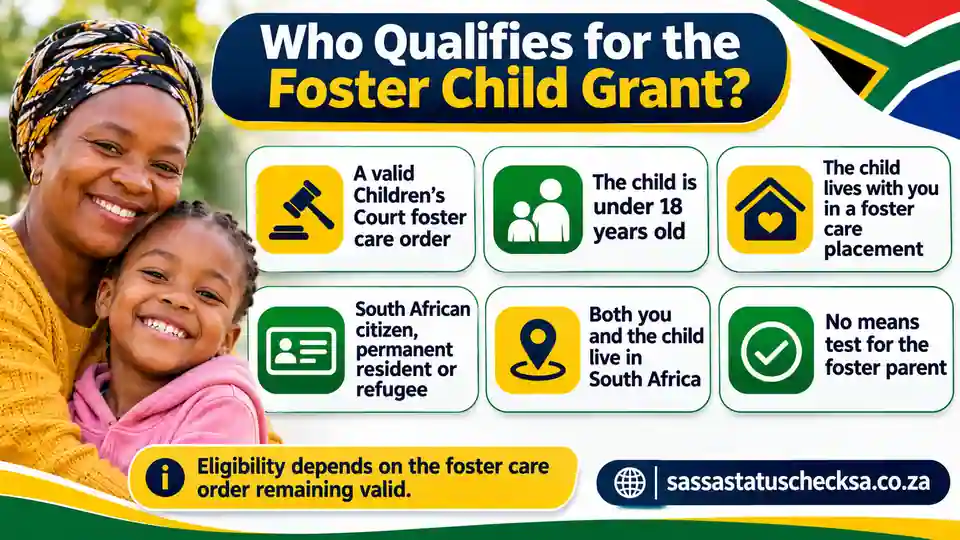
Foster Parent and Child: Identity, Residence and Age Requirements
- Recognised foster parent: The applicant must be the person named by the Children’s Court as responsible for the foster placement.
- Residence: Both the foster parent and the child must live in South Africa. The foster parent must be a South African citizen, permanent resident or qualifying refugee.
- Child’s age: The normal grant is for a foster child younger than 18. A specific continuation process may apply when an eligible young person remains in education; this is explained in the later renewal and age-18–21 section.
- Actual care: The child must remain in the foster parent’s care in line with the court order throughout the period for which the grant is claimed.
- Valid placement evidence: The court order must identify the child and foster parent and establish the lawful placement. SASSA must be able to verify it when assessing the grant.
The court-order requirement matters even where everyone agrees that a caregiver has been looking after the child responsibly. Foster care is a child-protection arrangement established through legal proceedings; SASSA does not turn an informal family arrangement into foster care by approving a payment form.
Is the Foster Child Grant Means-Tested?
No income means test is applied to the foster parent’s earnings for this grant. A foster parent does not lose eligibility simply because they are employed or their salary exceeds a Child Support Grant income threshold. The claim is assessed against foster-placement and other applicable grant conditions, not the ordinary low-income test used for some other grants.
This is a critical difference from the Child Support Grant, for which a means test normally applies. Some online guides confuse the two and publish income ceilings for the Foster Child Grant. Do not use those figures as foster-parent income limits. SASSA may still check identity, the legal placement, the child’s circumstances and any other applicable statutory conditions.
Important: no foster-parent income threshold
There is no general R4,500-per-month foster-parent salary cap for the Foster Child Grant. A working foster parent can qualify when the child is lawfully placed and the other requirements are met. The child’s own circumstances, where relevant to the law, are a separate question from the foster parent’s salary.
Can Grandparents, Relatives or Foster Parents of Several Children Apply?
A grandparent, aunt, uncle or other relative may qualify if that person has been formally appointed as the child’s foster parent by the Children’s Court. Without that order, family caregiving by itself is not enough. A caregiver without a court placement should seek guidance about the appropriate child-protection arrangement or another grant rather than assuming that a relative automatically qualifies for foster payments.
A foster parent may care for more than one child, but each child’s placement and grant award must be considered separately. Child-protection rules generally limit the number of children placed in one foster family, with exceptions for siblings, relatives and particular court decisions. Do not confuse those placement rules with the separate six-non-biological-child rule that applies to the Child Support Grant.
If a household cares for two children and there are two qualifying approved grants, the October 2026 rate would amount to R2,600 a month in total. That arithmetic does not replace the separate court orders or SASSA’s decision for each child.
Can a Foster Child Also Qualify for the Care Dependency Grant?
Yes, in a specific situation. A foster parent caring for a child with a severe disability may apply for a Care Dependency Grant as well as the Foster Child Grant when the child meets the additional care-dependency requirements, including the medical assessment and full-time special-care criteria.
That does not make two grants automatic for every foster child. The additional grant has its own eligibility rules and approval process, and the child’s disability must meet those rules. The income of foster parents is not taken into account for that specific Care Dependency application either.
Quick eligibility check: If you have a valid court order and the child lives with you in South Africa, you have the essential starting evidence for a Foster Child Grant enquiry. If you do not yet have the court order, begin with the social-worker and Children’s Court process explained below.
How to Get a Foster-Care Court Order Before Applying
A foster-care court order is the legal starting point for the Foster Child Grant. You do not obtain the order by filling in a SASSA grant form. The foster-placement process is handled through the Department of Social Development, an accredited child-protection organisation, a designated social worker and the Children’s Court.
There are two separate applications: first the child-protection process that determines whether foster care is appropriate; then, after the court has issued the order, the grant application at SASSA. Keeping those steps separate prevents confusion about who has authority to approve the placement and who pays the grant.
Step 1: Contact Social Development or an Accredited Child-Protection Organisation
Start by contacting your nearest Department of Social Development office or an accredited child-protection organisation. Explain the child’s circumstances and ask how a foster-care assessment is initiated. This might involve a child who has been orphaned or abandoned, whose safety is at risk, or who has experienced neglect or abuse. A social worker must assess the individual situation; family hardship by itself does not automatically result in a foster order.
Prospective foster parents should normally be adults aged at least 18 who are willing and able to care for the child and provide a suitable environment. Social-work screening considers the caregiver’s suitability and the child’s best interests. The department or organisation will explain which local office, social worker or court is handling the matter.
Step 2: Complete the Social-Worker Assessment
A designated social worker investigates the child’s need for care and protection and assesses the proposed foster parent. Depending on the circumstances, this can include interviews, a home visit, checks on the child’s wellbeing and consultation with people who have legal responsibilities for the child. The child’s views and involvement must be handled appropriately for their age and circumstances.
The social worker may ask for the caregiver’s identity document, the child’s birth certificate, and evidence relevant to the child’s situation. For example, death certificates can matter when parents have died, while an affidavit or other evidence may be needed if abandonment is alleged. These are court-placement assessment materials; the final SASSA grant document checklist is covered in the next section of this article.
If the child’s identity documents are missing, tell the social worker instead of assuming that the process must end. The government foster-care guidance provides for social-worker assistance with obtaining a birth certificate where necessary.
Step 3: The Children’s Court Considers the Placement
After the assessment, the social worker presents a report and recommendations to the Children’s Court. The court—not SASSA and not this website—decides whether the child needs care and protection and whether placement with the proposed foster parent is suitable.
The court may consider the child’s safety, the caregiver’s ability to provide a stable home, appropriate family involvement and the prospect of reunification where that is in the child’s best interests. The process does not follow a single guaranteed number of days. Court scheduling, assessments and the child’s circumstances differ between cases, so an online promise of a fixed four-week or six-month approval period would be misleading.
A social worker’s report is not the final order
The investigation and recommendation prepare the case for the Children’s Court. You need the court’s actual placement order before you can rely on it for the Foster Child Grant application.
Step 4: Check the Court Order, Then Approach SASSA
If the court approves foster placement, the order should identify the foster child, the appointed foster parent and the period of placement. Check the names and relevant dates with the court or social worker, and keep a usable copy with your records. The order’s duration matters because foster grants are connected to an ongoing lawful placement and may be affected when a placement expires or changes.
- Obtain the issued order.
Confirm that you have the formal Children’s Court placement order, not just an assessment appointment or recommendation.
- Organise the child’s records.
Keep your identity documents, the child’s available identity or birth records and the court documents together for the grant application.
- Apply for the grant through SASSA.
Visit the appropriate SASSA office with the required documents. Grant officers assess the application; the Children’s Court does not pay the grant.
- Keep track of the order’s end date.
Ask your social worker about reviews or extensions in good time. A court order does not necessarily remain valid indefinitely.
Applying for foster care through Social Development is free. Applying for the SASSA Foster Child Grant is also free. Do not pay a third party who claims they can sell you a court order, guarantee approval or unlock a grant payment.
Once you have a valid placement order, the next part of this guide explains the documents to prepare and how to apply for the SASSA Foster Child Grant. Court-order renewal, the child’s eighteenth birthday and possible education-based continuation are addressed later, because they involve different rules from the first placement decision.
Documents Required for a Foster Child Grant Application
Before applying for a SASSA Foster Child Grant, put the child’s legal placement documents and your identification together. The document that makes this application different from an ordinary child grant is the Children’s Court order placing the child in your foster care. Without that valid order, SASSA cannot treat an informal caregiving arrangement as an approved foster placement.
Not every foster parent will need exactly the same extra paperwork. Your marital status, identification documents, payment account, refugee status and the child’s age can affect what an official asks to see. The checklist below separates the essential starting documents from supporting records that apply in particular circumstances, so you can prepare without assuming that every item is mandatory for every household.
Identity Documents, the Child’s Birth Certificate and the Court Order
Start with your valid South African identity document and the child’s birth certificate. The normal identification route is a 13-digit barcoded ID or smart ID; SASSA also has procedures for applicants who do not yet have the required identity records. If a spouse’s ID is applicable to your circumstances, have it available as well.
Bring the current foster-care court order that names you as the foster parent and identifies the child. Check that the names, identity or birth details and placement period are consistent with the other documents. If the court has issued an extension or later order, carry that documentation too. The court order is proof of the legal foster placement; a social-worker referral or a letter from a relative is not a substitute for the issued order.
Valid Children’s Court placement order and any applicable extension or amendment showing the foster parent and child.
Your accepted identification and the child’s birth certificate, or the alternative-document process approved by SASSA when records are missing.
Take the original documents when available and prepared certified copies of documents where SASSA requests them. The final verification is done by SASSA, so an online list should not be treated as permission to submit altered, unofficial or expired paperwork. If a court order is about to expire, raise that with the social worker or court rather than assuming SASSA can extend the order itself.
Marital Status, Bank Details and School Attendance
SASSA may ask for proof of marital status, such as a marriage certificate, divorce order, spouse’s death certificate or the applicable affidavit. The 2026 application guidance also lists the spouse’s identification when the applicant is married. These records help confirm the applicant’s particulars; they do not create an income means test on the foster parent’s salary.
For payment details, prepare a bank account confirmation letter or recent bank statements for the account you want SASSA to use. SASSA’s 2026 beneficiary guidance refers to statements covering the last three months and an account in the beneficiary’s name. The official will confirm the accepted payment arrangements and verify the particulars. Never give your bank PIN, online password or one-time password to an unofficial website or someone offering to speed up the application.
If the foster child is of school-going age, bring available proof of school attendance. SASSA’s 2026 grant information says this record should be provided, but also states that failure to attend school or produce the certificate must not, by itself, result in refusal of the Foster Child Grant. For a young person older than 18 seeking a permitted education-based continuation, evidence of ongoing school or tertiary study has a more specific role. That extension is not automatic and is explained in the renewal section later.
Do you need payslips to pass a foster-parent income test?
No. The Foster Child Grant is not means-tested on the foster parent’s income. Do not use an income ceiling from the Child Support Grant or Care Dependency Grant to screen out foster applicants. SASSA can request additional information during verification, but that is different from imposing an ordinary foster-parent salary cutoff.
Applying as a Refugee or Without an ID or Birth Certificate
A recognised refugee may qualify for the Foster Child Grant. Bring the relevant valid refugee status and identification records, including the Section 24 documentation applicable to your case, together with the court order. If you are uncertain which documents are currently accepted, ask SASSA before relying on an unofficial list or a photocopy of an expired permit.
If you do not have your ID or the child’s birth certificate, do not assume you must abandon the application. South African Government service guidance describes an alternative-identification procedure: SASSA can explain its prescribed affidavit and supporting sworn statement requirements, and may take fingerprints and refer the applicant to the Department of Home Affairs for identification. Evidence that you have applied for an ID or birth certificate, a temporary ID, and certain school or clinic records may also be relevant according to the circumstances.
These alternatives are not a promise that any document will be accepted automatically. Tell the officer exactly which record is unavailable and ask which authorised substitute applies. Where Home Affairs must issue a missing document, keep proof of that application and follow the officer’s instructions. The foster placement must still be supported by an authentic, valid court order.
Keep the processes separate: A social worker can help with a child’s missing civil documents during the foster-care proceedings. SASSA decides which records it accepts for the subsequent grant application. Neither office can be replaced by a third-party “instant foster grant” form.
A Practical Foster Child Grant Document Checklist
Use this table before visiting the office. The first group covers the usual core records; the second group depends on individual circumstances. Take any additional documents specifically requested by your SASSA office, but do not let a competitor website’s very long list convince you that every item is always compulsory.
| Document or record | When to prepare it | What to check |
|---|---|---|
| Valid foster-care court order | Every foster grant application | Correct child, foster parent and placement period |
| Foster parent’s ID and child’s birth certificate | Normally required | Names and identity details agree; ask SASSA about accepted alternatives if missing |
| Proof of marital status and spouse’s ID | Where relevant | Correct current marital particulars |
| Bank confirmation or recent statements | For the selected payment account | Account belongs to the intended beneficiary and details are accurate |
| Valid refugee permit / refugee identification | If applying as a recognised refugee | Current status and documents accepted by SASSA |
| School attendance evidence | For school-going children; especially relevant to continuation after 18 | Current attendance or study evidence where applicable |
| Court extension or additional records | If placement has changed or SASSA requests further evidence | Latest lawful order and correct dates |
Before leaving home, place related documents together, check that you can explain any spelling or identity differences, and keep a separate copy of the court order and the appointment or office details. The application itself is free; nobody should demand a fee for a SASSA grant form. The next section explains what happens once the documents are ready.
How to Apply for the SASSA Foster Child Grant
Once the Children’s Court has legally placed the child in your foster care, the next task is to apply for the SASSA Foster Child Grant. The court approves the placement, but SASSA considers the social grant application and handles payment. You do not have to start the foster-care court proceedings again just to complete a normal grant application after a valid order has been issued.
The established route is to take your documents to a SASSA local or service office, complete the form with the official and keep the receipt. Some SASSA guidance also mentions a grant application portal, while the government’s foster-grant service page describes obtaining the form at an office. Because the availability of online grant services can change, confirm any specific foster-grant online option directly with SASSA before treating a web form as an authorised application route.
Where to Apply and How to Avoid Unofficial Online Forms
Use your nearest SASSA service office for a Foster Child Grant application or to confirm which officially supported service channel is currently handling that grant in your area. The government describes applying in person, with the application form completed in the presence of a SASSA officer. You do not need to buy the form; the service is free.
Do not confuse the Foster Child Grant with the separate SRD R370 status and application system. A website asking for an ID and cellphone number to check SRD status is not automatically a Foster Child Grant application or status checker. Likewise, a paid intermediary cannot issue a foster-care order, authorise the grant or guarantee a payment date.
The srd r350 status check information on our homepage relates to the separate SRD programme, now R370. It is not a way to check a Foster Child Grant application or payment.
Consider the child’s protection needs, assess the placement and issue or review the legal foster-care order.
Checks the foster grant application, records the outcome, manages an approved award and answers grant-payment enquiries.
Keep your own documents private when researching the process. This website is an independent information guide and does not collect applications, upload court orders, verify identities, access SASSA records or process grant payments.
Step by Step: Submitting the Grant Application at a SASSA Office
After you have a valid court order, these are the practical stages to expect. The order and duration will have already been determined by the Children’s Court; the steps below concern the separate grant application.
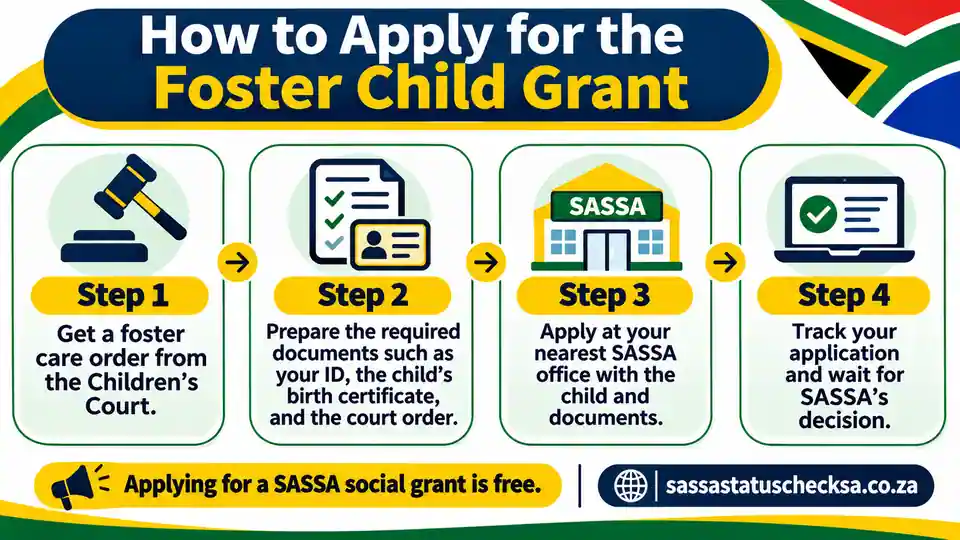
- Prepare your documents.
Take the court order, your accepted ID, the child’s birth certificate and the relevant additional records in the checklist above. If something is missing, ask about SASSA’s approved substitute-document procedure.
- Visit the appropriate SASSA office.
Explain that you are applying for a Foster Child Grant following a court-approved foster placement. Confirm which identification, payment and supporting information the official needs for your situation.
- Complete the application with the officer.
The government service instructions say the applicant or SASSA official completes the form in the officer’s presence. Review the details carefully rather than signing information you know is incorrect.
- Allow SASSA to check the records.
The official may verify the identities, child’s details, legal placement and payment information, or request additional documents where necessary. Ask clearly what is outstanding if the application cannot yet be treated as complete.
- Obtain and keep your receipt.
SASSA should provide a receipt as proof that you applied. Protect it and note the office, application date and any reference details available on it.
- Monitor official communication.
Keep your contact details current, respond to legitimate requests and follow up through SASSA when needed. Do not use a separate SRD R370 checker to infer the progress of this foster grant application.
You should not pay an application charge at the office or to an outside agent. If anyone offers to “approve” a foster grant immediately for a fee, verify the claim with SASSA before handing over money, account information or personal documents.
How Long Does Approval Take and When Can Payments Start?
The South African Government says a Foster Child Grant application may take up to three months to process. This is a published processing guide, not a guarantee that every file will be decided on a particular day. Missing or inconsistent information can require further checking; if the application has been pending longer than expected, ask SASSA about its status using your receipt details.
An important distinction is the date of the court placement. The government states that, when a foster grant application is approved, payment is due from the date the court placed the child in the applicant’s care. This differs from simply assuming every grant starts on the day a web form was filled in. SASSA must determine the effective award period and any resulting amount for the actual approved case.
The legal placement has been established. This does not alone mean the grant is already approved.
SASSA has been given an application to assess. Keep the receipt and respond to further requests.
SASSA confirms the award and relevant payment details. Ask about the effective date if earlier court placement matters.
Do not assume that a first bank deposit will appear exactly three months later, or that an online amount calculator can tell you what your individual arrears will be. The actual outcome depends on SASSA’s approved dates, eligibility checks and payment processing. Keep the court order and application receipt to support any enquiry about the effective payment period.
Missing Documents, Delays and How to Follow Up
If SASSA says your application is incomplete, ask which exact document or detail is outstanding. For example, a child’s name may differ between the birth record and court order, or the current order may not cover the claimed placement period. Resolve an identity issue with the relevant issuing authority and a placement-order issue with the social worker or court; SASSA cannot rewrite a Children’s Court order for you.
For a pending application, have your receipt or reference number, your own identification and the child’s relevant details ready when you speak privately to an authorised official. You can visit a SASSA local office or call the official toll-free enquiry line 0800 60 10 11. The government also lists [email protected] for grant enquiries. Do not send passwords, PINs, OTPs or more personal data than is necessary through an insecure message or third-party contact form.
- Not yet submitted? Use the document checklist and ask SASSA what the office still needs; an informal verbal enquiry is not a completed application.
- Submitted but awaiting a decision? Keep the receipt, record the dates of your enquiries and ask whether the agency needs additional information.
- Approved but payment has not arrived? Confirm the official award details and payment method with SASSA before assuming the award has been cancelled.
- Declined or suspended? Obtain the written reason and ask about the correct regular social-assistance review or appeal route; this is not the separate SRD appeal system.
What happens next? The next sections cover the children’s grant payment schedule, how to follow up on a payment, what happens when a court order approaches expiry and how a qualifying education-based continuation after age 18 is handled. Those issues are different from submitting the first grant application.
Foster Child Grant Payment Dates and Status Follow-Up
The SASSA Foster Child Grant is paid monthly to an approved foster parent. For payment scheduling, it falls under the broader Children’s Grants category. This matters when reading an official calendar: you may see “Children’s Grants” rather than a separate row for Foster Child Grant payments. The payment date tells you when the relevant grant group is scheduled for processing; it is not a promise that every bank account or payment method will reflect money at precisely the same hour.
If you are waiting for your first approval, have a payment problem or need to check a particular application, follow up through SASSA itself. The SRD R370 monthly application and status checker is a different service and should not be presented as a Foster Child Grant status tool.
Foster Child Grant Payment Dates for November and December 2026
SASSA revised its normal November 2026 grant schedule because of the local government elections. Under that revised arrangement, Children’s Grants, including the Foster Child Grant, are scheduled for Tuesday, 3 November 2026. Some older annual tables still say Thursday, 5 November; for November, that date is instead reserved for beneficiaries whose grants are under review. The November adjustment is a one-off change, not a new permanent rule for every month.
For the next scheduled months, the previously announced 2026/27 calendar returns to the regular Children’s Grants payment group dates. Here are the relevant dates in one place:
| Grant month | Children’s Grants date | Important note |
|---|---|---|
| November 2026 | Tuesday, 3 November 2026 | Revised election-period date; 5 November is for applicable grant reviews |
| December 2026 | Friday, 4 December 2026 | Normal Children’s Grants schedule resumes |
| January 2027 | Thursday, 7 January 2027 | Published 2026/27 Children’s Grants schedule |
These are published group payment dates, not individual approvals, banking confirmations or guarantees for an account under review. SASSA may issue further operational changes.
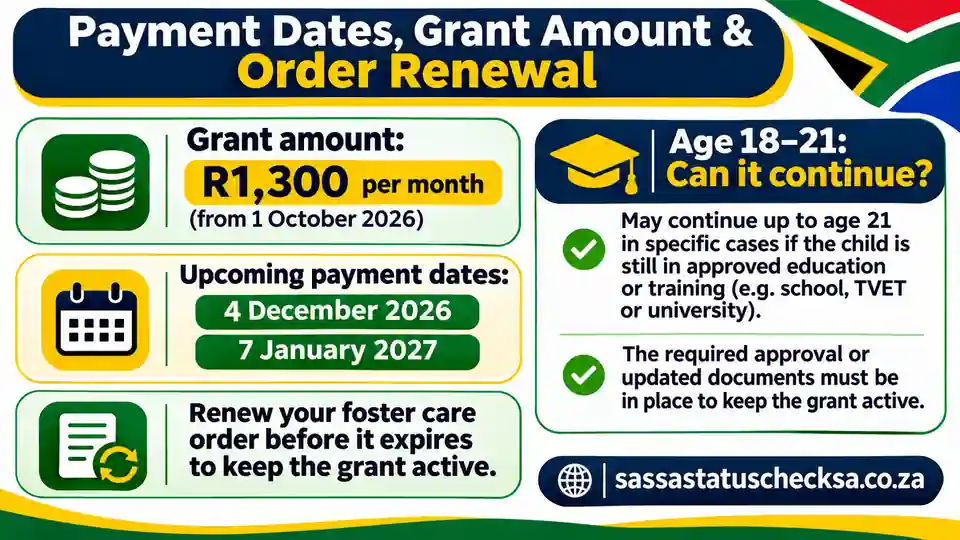
For the full calendar beyond these months, see our SASSA payment dates guide. It covers the different standard grant groups in one place. Do not substitute the separate SRD payment window for the Foster Child Grant schedule.
Why November 5 appears on some websites
That was the originally announced November 2026 Children’s Grants date before SASSA’s election-related revision. For ordinary Children’s Grants in the revised November arrangement, use 3 November. If SASSA has formally placed your particular grant in a review process, follow the agency’s individual communication instead.
How to Check Foster Child Grant Application or Payment Status
People often search for “foster child grant status check”, but an official status route for this grant should not be confused with the website used for SRD R370 applications. If your grant is still being assessed, or an approved payment has not appeared, the dependable next step is to ask SASSA for an update on the specific foster grant record.
Have the reference or receipt you received from SASSA, along with the information the agency asks you to use for identification. It helps staff locate the correct application rather than treating it as a new SRD enquiry.
Call the toll-free SASSA number 0800 60 10 11 and explain whether your question is about application progress, a missing payment or a court-order update.
If the matter needs documents checked or an officer to update the record, take your receipt, accepted identification and relevant placement order to your local SASSA office.
Ask SASSA to confirm that your approved phone number, contact information and selected payment details are accurate so important requests for information do not go unnoticed.
Do not enter a child’s identity number, court documents, bank PIN or one-time password on an unrelated third-party “instant foster grant status” page. Only SASSA can confirm the real status of an individual Foster Child Grant application, review or payment.
What to Do If a Foster Child Grant Payment Is Late
First, distinguish a grant-wide date change from a problem affecting one beneficiary. When SASSA officially revises a month’s payment calendar, that is not the same as your personal grant being declined. When your payment is missing despite the announced date, there may be a separate administrative, document, court-order or banking issue that SASSA needs to check.
- Confirm the correct payment group and month.
Check the latest Children’s Grants date rather than older screenshots or SRD dates. For November 2026, remember the revised 3 November schedule.
- Check the payment method.
If you normally receive money in a bank account, check your own account information. Do not assume payment is missing because you did not withdraw cash on the exact grant date.
- Look for an official SASSA review request.
Read any genuine notice or SMS asking you to attend a grant review or supply information, and respond through SASSA’s verified channels. An ignored review request can affect continued payment.
- Ask SASSA to identify the reason.
Use the toll-free helpline or an office, take your receipt and current court order, and ask what action or documentation is outstanding. Record the date of the enquiry and the guidance provided.
If the grant has been formally suspended, refused or stopped, ask SASSA for the written decision and the correct review or appeal procedure. That is different from an ordinary processing delay; the section on problems and decisions later in this guide explains the distinction. Do not submit a fresh application simply because a bank balance appears late unless SASSA instructs you to do so.
Protect your information: SASSA officials do not need your banking PIN or OTP to investigate a grant payment. Do not pay anyone to “release” or “speed up” a Foster Child Grant payment.
How Foster Child Grant Payments Are Made
For an approved application, SASSA arranges payment using an accepted method. The government explains that social grants may be paid by electronic deposit into a bank or Postbank account, through an authorised cash pay point where applicable, or through an approved institution administering the benefit. The suitable current method and its requirements must be confirmed with SASSA for your specific grant.
Current SASSA guidance emphasises keeping the beneficiary’s banking information accurate and making sure the designated account is suitable for electronic transfers. Where a financial institution charges a service fee, that is a banking cost rather than a SASSA application fee. If your account has changed, notify SASSA through its supported process rather than asking an unofficial website to change the details on your behalf.
Money already deposited into a bank account generally does not need to be withdrawn on the precise payment date. This can help families avoid unnecessary queues. If a SASSA communication tells you a grant is under review, however, deal with the review itself rather than assuming the money will arrive automatically on another advertised group date.
Foster Care Order Renewal, Expiry and the Age 18–21 Rules
The Foster Child Grant is tied to a lawful foster-care placement. Receiving a payment for several months does not mean the original court order is valid forever. The Children’s Court determines the placement period, while SASSA checks whether the grant can continue under the applicable rules. Keeping both sets of records current is particularly important when the court order approaches its end date or the child reaches adulthood.
There are also exceptional education-related rules under which a Foster Child Grant may continue after 18. These have additional conditions: education or training, a provincial Social Development decision and continuing evidence provided to SASSA. No family should assume that turning 18 always causes an immediate birthday-day payment stop, or that simply attending college guarantees a grant through age 21.
What Happens When a Foster-Care Court Order Expires?
Every foster parent should know the placement’s start date and expiry date as written in the issued court order. A foster-care arrangement normally lasts only for the period stated in that order unless the lawful process extends or otherwise changes it. The Children’s Court can consider an extension following the appropriate social-worker recommendations, but SASSA itself does not issue or renew a foster-care order.
SASSA’s grant-review rules expressly identify expiry of the foster-care order as a reason to review a Foster Child Grant. An expired or changed placement can therefore disrupt payment and may require new court documentation or a status update before the agency can confirm continued eligibility. Do not assume a grant will renew automatically because the child is still living with you.
Use the expiry date printed on your own order
Do not rely on a general statement that every foster order lasts exactly two years. Orders, extensions and court directions depend on the circumstances. Record the actual end date and discuss the review process with the social worker well before that date.
How to Renew the Foster-Care Placement and Update SASSA
Renewing the foster-care placement and keeping the SASSA grant current are connected but different tasks. The social worker and Children’s Court deal with the placement. SASSA deals with the financial grant record. Start the discussion early enough to allow for assessment and court scheduling, rather than relying on an unverified fixed renewal timetable.
- Check the placement’s legal end date.
Locate your latest issued court order, including any amendment or extension, and confirm which date actually applies.
- Speak to the responsible social worker or child-protection organisation.
Explain that the order is approaching expiry and ask what assessment, documents or referral the court will need to consider continuation.
- Follow the Children’s Court process.
Where appropriate, the court may issue an extended or different order. Keep the formally issued document; an informal assurance that the order will be renewed is not a replacement.
- Provide the updated order to SASSA.
Ask the service office to record the current court decision against the correct Foster Child Grant case and confirm whether any other verification is outstanding. Keep your proof of submission.
If a court date is delayed or an order has already expired, explain the situation to both the social worker and SASSA. Ask what interim arrangements or case-specific steps may lawfully apply; do not assume uninterrupted payments or that a new court order retrospectively repairs every missed payment. The appropriate agency must evaluate the individual record.
What Happens When the Foster Child Turns 18?
Ordinary Foster Child Grant eligibility is linked to a child under 18. The regulations set out the usual age-related lapse at the end of the calendar year in which the foster child turns 18, while providing for a separate, conditional continuation where an eligible young person remains in care to finish education or training. These details matter: the rule is more nuanced than saying the payment always stops on the child’s eighteenth birthday.
The conditional continuation can extend up to the end of the calendar year in which the young person turns 21, but only when the required circumstances are met. The regulations provide for the provincial head of Social Development to allow the young person to remain with the current alternative caregiver to complete education or training, and require that provincial decision to be submitted to SASSA annually. The 2026 SASSA guidance also calls for supporting proof of ongoing school or eligible tertiary study.
| Milestone | What to check | Who to contact |
|---|---|---|
| Before age 18 | Current placement order, upcoming expiry and any education-continuation arrangements | Social worker / Social Development and SASSA |
| In the year the child turns 18 | Usual age-related lapse rule and whether a qualifying continuation decision is in place | Provincial Social Development and SASSA |
| After 18, up to the permitted age limit | Approved continuation, education/training proof and annual submission of the provincial decision | Provincial Social Development and SASSA |
| Approaching age 21 | Applicable end-of-calendar-year limit and future support options; do not assume further foster payments | SASSA / Social Development |
For example, a young person who is still studying does not qualify for continued payment solely because they have a school or college registration letter. The appropriate provincial approval and annual information for SASSA remain crucial. Start the conversation with the social worker before the eighteenth birthday so any required assessment, decision and supporting documents can be arranged. This is a conditional continuation, not an automatic conversion to another social grant.
Changes in Foster Placement, SASSA Reviews or Stopped Payments
If the foster child leaves the approved placement, a court issues a different care order, the foster parent changes or a relevant family circumstance changes, inform the responsible social worker and SASSA promptly. A Foster Child Grant is paid in connection with the legally recognised care arrangement. Keeping payments after the arrangement has materially changed without notifying the agency can create serious administrative difficulties.
Respond to genuine SASSA review requests, including notices asking you to visit an office or bring updated documentation. Review is not necessarily the same as an immediate rejection; SASSA may be checking the continuing court placement, identity particulars, permitted age continuation or another relevant eligibility condition. Ask for clear instructions about what is needed and preserve copies of what you submit.
Give SASSA the updated legal placement details and keep your own copy of the issued order.
Tell the social worker and SASSA. Do not assume the existing foster parent’s grant simply transfers to another caregiver.
Ask about the provincial decision, school or tertiary records and annual submission requirement before an interruption occurs.
Read the reason and any deadline, respond through SASSA and request the appropriate written decision if the grant is refused, suspended or cancelled.
When there is a formal negative decision, the correct review and appeal route for an ordinary Foster Child Grant differs from the SRD R370 appeal system. Keep the notice and dates rather than relying on a generic SRD appeal page. The next section of this guide explains what to do when the grant is declined or stopped.
What If the Foster Child Grant Is Declined, Suspended or Stopped?
A refused SASSA Foster Child Grant application is not the same as an approved grant that has missed a payment. A court order that has expired creates a different problem again. Before taking action, find out which decision SASSA has made, whether it has issued a notice and what reason is recorded on your file.
Keep the application receipt, current foster-care order, relevant school or extension documents and all written notices together. You will need different evidence depending on whether the problem concerns eligibility, the grant record, a court-order review or the payment channel.
Why a Foster Child Grant Application May Be Declined
SASSA may refuse an application when it cannot confirm a qualifying placement or another necessary condition. For example, the court order may be missing or not valid for the applicant, the child may no longer be in that foster parent’s care, or required identity and residence details may not match the documents presented.
Confirm the child is placed with the named foster parent and check the order’s validity and dates with the social worker or Children’s Court.
Ask SASSA which specific record needs correcting or which alternative proof can be considered.
Report the change and provide the updated court or placement documents. A grant cannot simply continue under an outdated foster arrangement.
The foster parent’s earnings are not a standard means-test limit for this grant. If income is cited as the sole reason, request the written legal basis and a formal explanation rather than accepting an invented threshold.
Ask for the written decision and reasons. A verbal remark at a counter or an unclear status message is not enough to identify the proper remedy. An incomplete application may call for missing information, while a negative formal decision may require an appeal within a deadline.
How to Appeal a Rejected Foster Child Grant Decision
If SASSA has made a formal decision refusing your application or affecting your existing grant and you disagree with that decision, the regular social-assistance appeal framework applies. Under the amended Social Assistance Act, the appeal route is through the Independent Tribunal for Social Assistance Appeals (ITSAA), generally within 90 days of SASSA’s decision. Act as soon as you receive the notice; do not assume that an informal enquiry pauses the deadline.
- Get the reason in writing.
Request or retain the decision notice showing what was decided and when. Note the grant type and reference number.
- Prepare your appeal explanation.
Explain clearly why you disagree. Include relevant existing documentation, particularly a valid foster-care order, proof of care or a corrected identity record where applicable.
- Confirm the current official appeal form and delivery method.
Ask SASSA or the Department of Social Development how to lodge the appeal with ITSAA. Keep a copy of the completed submission and proof that it was received.
- Track the outcome and respond to requests.
Keep the appeal receipt and written correspondence, and provide any further information through the official channel if requested.
Not the SRD R370 appeal process
The Foster Child Grant is an ordinary social grant linked to a Children’s Court placement. Do not use an SRD status checker or SRD appeal form as a substitute for the official Foster Child Grant appeal process. A dispute about the court placement itself must be handled through the appropriate child-protection or court process, not decided by the grant appeal tribunal.
Why an Approved Grant May Be Suspended, Reviewed or Lapse
SASSA can review an existing foster grant, including when the placement order expires or relevant information changes. A review is an assessment of whether eligibility continues; it does not automatically mean fraud or cancellation. If SASSA asks for updated evidence, respond within the instructions given on the notice.
Payments may be suspended or a grant may lapse where the applicable rules are no longer met, such as when the child leaves the foster placement, the order is no longer valid, the required review information is not supplied, or certain statutory lapse events occur. The reason and effective date matter. A revised Children’s Grants payment schedule, by contrast, is not a grant cancellation.
| What happened? | What it usually means | First practical step |
|---|---|---|
| Application declined | SASSA made a negative eligibility or documentation decision. | Obtain written reasons and check the formal appeal deadline. |
| Under review | SASSA is confirming the continuing conditions of an awarded grant. | Respond to the review notice with the specific documents requested. |
| Payment suspended | An awarded grant’s payment has been formally paused. | Ask for the suspension reason, effective date and restoration procedure. |
| Grant lapsed or placement ended | Grant entitlement or the underlying foster-care arrangement may have ended. | Check the court order with the social worker and the grant record with SASSA. |
| Payment simply late | Money may not yet have reached the selected account or payment channel. | Confirm the latest official grant payment date and bank/payment details with SASSA. |
Do not assume every stopped payment will be restored automatically or that all missed months will be reimbursed. SASSA must consider the particular notice, court documentation and applicable restoration rules.
What to Bring When You Request a Review or Follow-Up
For a grant-record follow-up, prepare the foster parent’s identity document or accepted alternative, the child’s identifying records, the most recent court placement or extension order, the original SASSA application receipt if available, and any decision, review or suspension letter. For an age-18 education continuation, also take the current school or relevant study evidence and the documents requested for provincial approval.
Explain the issue precisely: “My application was declined”, “I received a review notice”, “The court order was extended but payments stopped” or “My approved payment has not arrived”. That distinction helps SASSA direct you to the correct procedure rather than treating every problem as a new application.
Keep private records private. Submit identity documents, court records and account information only through appropriate official channels. Our independent information website cannot access SASSA’s grant records, issue court orders or lodge an appeal on your behalf.
Foster Child Grant FAQs and Next Steps
These questions cover the details foster parents most often need to clarify after reading the full guide: the current amount, court orders, grant status, multiple children, renewal and what happens around age 18. Open a question to see the short answer.
Foster Child Grant Amount and Eligibility FAQs
How much is the SASSA Foster Child Grant in November 2026?
The amount is R1,300 per qualifying foster child per month from 1 October 2026. The preceding rate from April through September 2026 was R1,290.
Do I need a Children’s Court order if the child is my relative?
Yes. A formal foster-care placement order is central to this grant, even when a grandparent, aunt, uncle or other relative has been looking after the child for years. Informal care on its own is not a Foster Child Grant approval.
Is the SASSA foster care grant means-tested?
No foster-parent income means test applies to this grant. Eligibility instead depends on the court-ordered placement, the child’s care, identity, residence and the other applicable conditions. This differs from the Child Support Grant.
Can I receive a Foster Child Grant for more than one child?
Yes, where each child is covered by an eligible foster-care placement and the requirements are met. The award is assessed in respect of each qualifying child. Ask SASSA about individual cases and any relevant placement limits rather than assuming that caring for several children automatically creates several awards.
Application, Payment and Grant Status FAQs
Can I apply for the Foster Child Grant online?
The South African Government service guide directs foster parents to apply at a SASSA office with the relevant documents and explains that the service application form is provided there. Do not confuse an SRD R370 online application with the Foster Child Grant application.
When is the Foster Child Grant paid each month?
It is normally scheduled within the Children’s Grants payment group. The revised November 2026 group date was 3 November; the announced December 2026 group date is 4 December. The latest official calendar and the beneficiary’s payment arrangements should be checked for a particular month.
How do I check a Foster Child Grant application or payment?
Use the application receipt or reference details to follow up through SASSA. Ask whether the application is pending, approved, declined or under review and confirm which payment channel is recorded. The separate SRD R370 status page is not a verified status service for Foster Child Grant applications.
Can I also receive a Care Dependency Grant for the same foster child?
In some circumstances, yes. A foster parent caring for a child with a qualifying severe disability may be eligible for a Care Dependency Grant as well as the Foster Child Grant for that child, subject to the separate Care Dependency requirements and medical assessment. It is not automatic.
Court Order, Renewal and Age 18–21 FAQs
What happens if the foster-care court order expires?
The order is a core requirement of the grant. Speak to the social worker or Children’s Court about the placement review or extension and give SASSA the current documentation. Do not assume that an expired order renews automatically.
Does the Foster Child Grant stop automatically on the eighteenth birthday?
The standard grant is for children under 18, but a qualifying education-based continuation may be possible toward age 21 if the relevant provincial authority approves it and the required evidence is provided. Ask about the continuation procedure well before the child’s eighteenth birthday.
Can I appeal if SASSA rejects or stops the grant?
A formal adverse SASSA decision on an ordinary social grant can be challenged through the applicable Independent Tribunal for Social Assistance Appeals process. The usual statutory limit is 90 days from the decision. Obtain written reasons promptly and confirm the current official appeal form and delivery instructions.
What if the child returns to their biological parent or leaves my care?
Tell the social worker and SASSA. The Foster Child Grant is tied to the lawful foster placement and the child continuing in that care. A change in placement can affect entitlement and may require new court documentation.
Your Next Steps as a Foster Parent
The most useful first action depends on where you are in the process. If there is no foster-care court order yet, start with the social worker and Children’s Court process. If the order is already valid, prepare the SASSA application documents and keep the receipt. If the grant is already awarded, track the placement expiry, respond to review notices and check the Children’s Grants payment calendar when necessary.
- Confirm the foster-care order names the responsible foster parent and is still valid.
- Keep the child’s documents, SASSA application receipt and any review notices together.
- Use the correct government channel for grants and the social worker or Children’s Court for placement orders.
- Do not miss a written appeal deadline, court-order review or requested education-continuation document.
The SASSA Foster Child Grant can help support a child in lawful foster care, but it depends on accurate records and continued eligibility. Use the steps in this guide to prepare, follow up and respond to changes without relying on unofficial application forms or unverified status websites.