SASSA Child Support Grant 2026: R580, Eligibility & How to Apply
The SASSA Child Support Grant provides R580 per month for each qualifying child under 18. Parents and other eligible primary caregivers can apply if they meet the relevant residency, caregiving and income requirements. Some relatives caring for orphaned children may qualify for an additional top-up.
This guide explains the grant amount, who can apply, what documents to prepare and how to follow up with SASSA. It also explains how the Child Support Grant differs from the SRD R370 relief programme.
Read government Child Support Grant guidanceYou are visiting SASSA Status Check SA, an independent information website, not a SASSA office or application service. Enter personal details only through a verified government channel.
What Is the SASSA Child Support Grant?
The Child Support Grant is a monthly social grant administered by the South African Social Security Agency (SASSA) to help an eligible primary caregiver meet a child’s everyday needs. The support is intended to help with the costs of raising a child, including food, clothing, transport and other necessities. It does not replace the caregiver’s responsibility to support the child.
It is the caregiver who applies on behalf of the child. Approval depends on the circumstances of the caregiver and child, including the income means test, where they live and who is responsible for the child’s day-to-day care. A child simply being under 18 does not guarantee that a grant will be approved.
Who is considered a primary caregiver?
A primary caregiver is the person mainly responsible for looking after a child. This may be a mother, father, grandparent or another eligible caregiver. A relative who is not the child’s parent may need to show evidence that the child actually lives in their care, such as a sworn statement or relevant school or social worker documentation.
The caregiver does not automatically need a Children’s Court foster-care placement order for the ordinary Child Support Grant. Formal foster care is a different grant category with its own requirements. We explain the distinctions further down this guide.
Is this the same as the SRD R370 grant?
No. The Child Support Grant is a child-related social grant, while SRD R370 is a separate relief programme with its own adult eligibility rules and monthly status process. Using the SRD online status form will not tell you whether a Child Support Grant application has been approved.
For a Child Support Grant application or payment enquiry, use SASSA’s child-grant channels and keep the application receipt you receive when applying. Later in this guide we explain the appropriate follow-up steps.
How Much Is the Child Support Grant in 2026?
The standard SASSA Child Support Grant amount is R580 per child per month from 1 April 2026. It increased from R560 under the 2026 social-grants adjustment. There is no additional October 2026 increase to the standard Child Support Grant in the published 2026 grant schedule.
The amount applies to each child whose grant is approved. For example, a caregiver with two qualifying children receiving the standard grant would receive R1,160 per month in total. The number of approved children and each child’s eligibility determine the household’s actual grant amount.
| Approved children | Monthly total |
|---|---|
| 1 child | R580 |
| 2 children | R1,160 |
| 3 children | R1,740 |
These totals are simple examples for children receiving the ordinary grant. They are not a promise of approval, and additional eligibility rules apply to caregivers who look after children who are not their biological or legally adopted children.
What is the Child Support Grant Top-Up?
The Child Support Grant Top-Up adds R290 to the ordinary R580 grant for eligible children in qualifying orphan-care arrangements. That makes the combined payment R870 per child per month where SASSA approves both the standard grant and the top-up.
It is not an automatic increase for every Child Support Grant beneficiary. The top-up is aimed at eligible relatives caring for orphaned children and requires supporting information about the child’s parents and the caregiving arrangement. SASSA may ask for both parents’ death certificates or, in qualifying circumstances, a death certificate for one parent and an affidavit explaining that the other parent’s whereabouts are unknown. The applicable caregiver, residence and means-test conditions must still be satisfied.
A caregiver who is unsure whether the top-up applies should ask SASSA about the Child Support Grant Top-Up specifically rather than assuming that receiving the R580 base grant means the additional R290 will be paid automatically.
Who Qualifies for the SASSA Child Support Grant?
The Child Support Grant is for a person who is actually responsible for raising a qualifying child and whose income meets SASSA’s rules. Being a parent is not the only way to qualify: a grandparent or another relative may also apply when they are the child’s primary caregiver. The grant is assessed for the caregiver and child, not awarded automatically to every family with children.
Eligibility rules for the caregiver and child
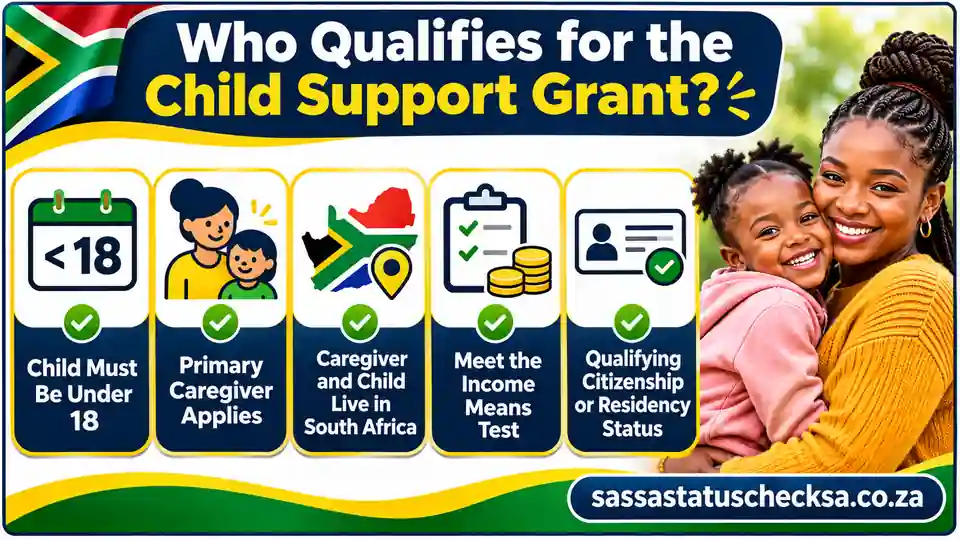
SASSA checks the caregiver’s status, where both people live, who looks after the child and the family’s income. The main requirements are:
- Caregiver: The applicant must be the child’s primary caregiver and a South African citizen, permanent resident or refugee.
- Residence: Both the applicant and the child must live in South Africa.
- Child’s age: The child must be younger than 18 years.
- Living arrangements: The child must normally live with the primary caregiver and must not be cared for in a state institution.
- Care payment: The caregiver must not be receiving remuneration specifically for looking after the child.
- Income: The caregiver, and their spouse if married, must meet the Child Support Grant means test explained in the next section.
These are the main rules, not a guarantee of approval. SASSA reviews each application and may ask for evidence about the household’s circumstances.
Can a grandparent, aunt or other relative apply?
Yes, when that person genuinely provides the child’s day-to-day care. A non-parent applicant should be prepared to show why they are the primary caregiver. Depending on the case, SASSA may accept an affidavit from a police official or biological parent, a social worker’s report, or a letter from the child’s school principal. We will cover the document checklist in the next writing chunk.
A primary caregiver can generally claim for up to six children who are not their biological or legally adopted children. This limit does not mean every family is limited to six children in total; it is a rule concerning children outside those two relationships.
What if someone else already receives a grant for the child?
Only the person recognised as the primary caregiver should receive the Child Support Grant on behalf of a particular child. If care arrangements have changed, explain the situation to SASSA rather than submitting conflicting applications or assuming the existing payment will automatically transfer. Keep records that help show who now looks after the child.
What Is the Child Support Grant Income Limit in 2026?
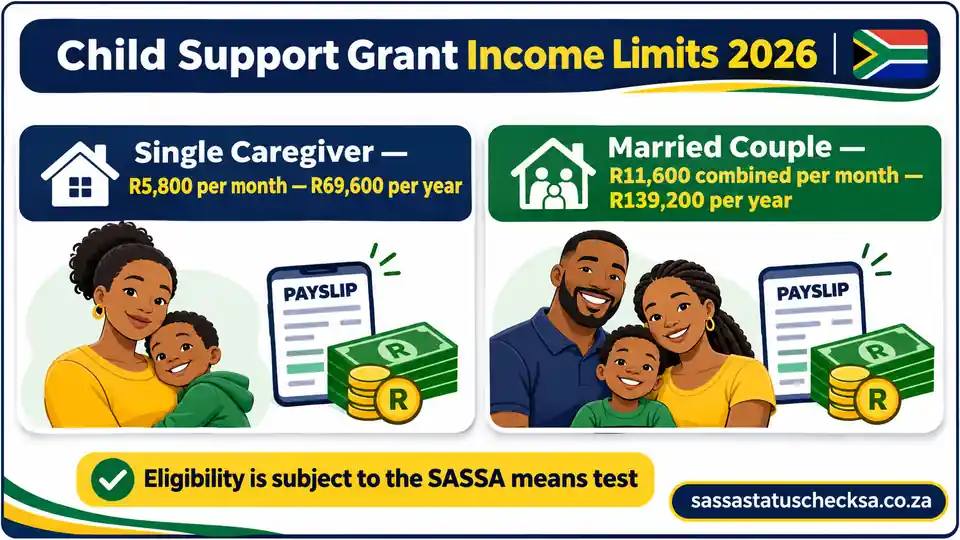
For the 2026 Child Support Grant means test, a single caregiver’s income must not exceed R5,800 per month. For a married applicant, the couple’s combined income must not exceed R11,600 per month. SASSA applies these limits when assessing financial eligibility; earning below the limit does not guarantee that every other grant requirement has been met.
| Caregiver status | Monthly income ceiling | Annual equivalent |
|---|---|---|
| Single caregiver | R5,800 | R69,600 |
| Married caregivers (combined) | R11,600 | R139,200 |
Amounts shown are the 2026 income thresholds, not the amount of money paid by the grant. The standard approved grant remains R580 per eligible child per month.
How does the means test work?
The means test is SASSA’s assessment of whether the applicant falls within the permitted income level. If you are married, the couple’s combined income matters, not just the income of the person who fills in the form. SASSA may request evidence of earnings or other relevant income and makes the final eligibility decision under its rules.
Use the table to understand the published limits, but do not guess how unusual income or a change in household circumstances will be treated. Explain those details accurately during the application.
Income examples for a single or married caregiver
Example 1: A single caregiver with relevant monthly income of R5,600 is below the R5,800 ceiling. That meets the published income threshold, but SASSA still needs to confirm the other eligibility conditions.
Example 2: If a single caregiver’s relevant monthly income is R6,000, it is above the R5,800 threshold and does not meet the published income limit.
Example 3: A married couple with combined relevant monthly income of R11,200 is below the R11,600 ceiling, while combined income of R12,000 is above it. SASSA determines the actual income counted for each application.
The next section explains which documents to prepare to show your identity, the child’s details and your income or caregiving arrangements.
Application preparation
Documents Needed for a Child Support Grant Application
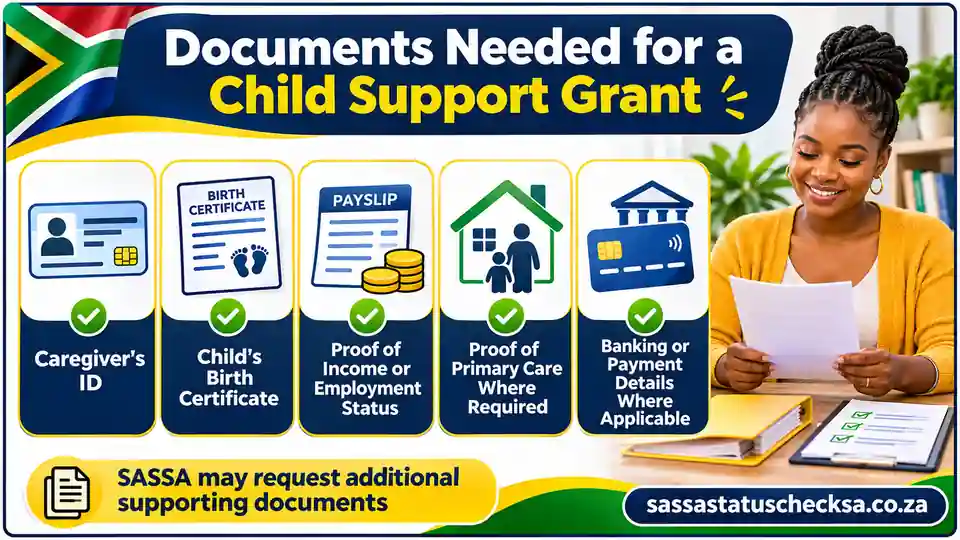
Getting your documents together before you visit SASSA can reduce the chance of a return trip. Most caregivers should start with their own identity document, the child’s birth certificate, and information about their household income. Other documents depend on whether you are married, caring for someone else’s child, or applying in special family circumstances.
Basic document checklist
| Document | Who needs it and why |
|---|---|
| Caregiver’s ID and child’s birth certificate | The usual starting documents for identifying the applicant and child. SASSA will explain accepted alternatives where official documents are missing. |
| Income and bank information | Recent payslips or other income evidence, information about child maintenance, and bank statements or account confirmation if requested for the means test or chosen payment account. |
| Marital or family records | Marriage certificate, relevant divorce/custody order, or parent’s death certificate/missing-person evidence, where applicable. |
| Proof of primary care | If you are not the child’s parent, bring evidence showing that the child lives with you and you provide everyday care. |
| School or clinic records | Useful supporting records when available. A missing school-attendance letter alone should not automatically disqualify an otherwise eligible application. |
Bring the originals and copies of the documents you have, and ask SASSA whether any copy needs to be certified. The exact evidence requested can vary with your family circumstances and the application channel.
Extra proof if you are not the child’s parent
A grandparent, aunt, uncle or another eligible caregiver does not automatically need a Children’s Court foster-placement order to apply for the standard Child Support Grant. SASSA must still be satisfied that you are the child’s actual primary caregiver. Proof might include an affidavit from the biological parent, a police official’s affidavit, a social-worker report, or a letter from the child’s school principal.
If a parent is deceased or missing, take the death certificate or available evidence of the disappearance, such as a police report, if relevant. Explain your circumstances truthfully to the SASSA official rather than presenting a document that does not describe the child’s living arrangements.
What if you do not have an ID or birth certificate?
Missing documents do not always end the application process
Do not assume you must abandon the application. Government guidance provides an alternative procedure for missing identity or birth documents. Ask SASSA about its prescribed affidavit format and what a Commissioner of Oaths must witness; the commissioner should not be a SASSA official. You may also be asked for proof that you applied to the Department of Home Affairs, a temporary ID if available, and supporting statements or a clinic card or school record.
Start the process of getting the missing official documents through Home Affairs as soon as you can. These alternatives are assessed by SASSA; they are not a promise that the grant will be approved without further verification.
Application steps
How to Apply for the Child Support Grant
You can apply through a SASSA office or service point, and SASSA also operates an online-services portal for eligible grant applications. The office process is the most straightforward fallback when you need help with documents, identity verification or an online service that is unavailable. Applying is free.
Apply at a SASSA office: step by step
- Prepare your documents. Use the checklist above and take additional records that fit your circumstances.
- Visit a SASSA office or service point. Confirm its operating arrangements if you are travelling a long distance.
- Complete the application with a SASSA official. Answer questions about the child, your role as caregiver, household income, and other relevant circumstances. SASSA may ask for additional verification.
- Confirm your payment details. Ask what payment methods are currently available and provide details only to SASSA through its official channels.
- Keep the application receipt. It is your proof that you applied and may help if you need to follow up with SASSA.
Can you apply for a Child Support Grant online?
Official SASSA Services Portal
SASSA’s own Services Portal offers account registration and information about grant applications. Start at the official SASSA Services Portal and check which Child Support Grant options are available after you register or sign in. Follow its current instructions, and keep any confirmation or reference it gives you. The portal may change or be unavailable for maintenance; if the relevant submission option is missing, contact SASSA or use an office instead.
The SRD R370 application and status website is a different service and should not be used to submit a Child Support Grant application. Never enter identity numbers, banking details or one-time passwords into this independent information website.
What happens after you apply?
SASSA’s government guidance says processing may take up to three months. If your application is approved, payment is generally calculated from the date you applied, not from the day you first receive a decision. This is not a guarantee of a particular payment date.
Keep your receipt and any updates from SASSA. If the application is declined, SASSA should give reasons and there is a route to challenge the decision. The next section of this guide explains how to follow up on a Child Support Grant application without confusing it with an SRD R370 status check.
After your application
How to Check a Child Support Grant Application Decision
After submitting a Child Support Grant application, keep the receipt SASSA gave you and the contact information linked to your application. A receipt proves that you applied; it does not mean the grant has been approved. SASSA’s published guidance says processing may take up to three months, so there is no universal instant approval or guaranteed 30-day result.
How to follow up on a pending application
You can check what has happened to your application by contacting SASSA directly at 0800 60 10 11 or visiting the SASSA office handling your application. Have your receipt available when speaking to the agency so staff can identify the correct application. If you registered for an official SASSA digital service, use only any enquiry or notification feature that service actually provides; do not assume a public online Child Support Grant status checker exists.
What if your Child Support Grant application is declined?
SASSA should notify you in writing and explain why the application was unsuccessful. Read the reason carefully, including whether the problem relates to the means test, evidence about the child’s care, or missing documents. If you disagree with the decision, the government explains that you may appeal to the Minister of Social Development within 90 days of receiving notification. This is different from appealing an SRD R370 decision for a particular month.
If your application is approved, SASSA generally calculates the entitlement from the date you applied. That does not guarantee the first deposit will arrive immediately: the decision, processing and payment arrangements must still be completed. Keep letters, receipts and any SASSA instructions for your own records.
Payment calendar
Child Support Grant Payment Dates for 2026/27
Children’s Grants are ordinarily paid after Older Persons and Disability Grants in SASSA’s monthly payment sequence. Their date is not automatically the third day of the month. SASSA may revise a particular month’s schedule, so use the announced dates rather than assuming that every payment will arrive on the same weekday.
When are children’s grants paid?
| Payment period | Children’s Grants payment date | What to know |
|---|---|---|
| November 2026 | Tuesday, 3 November 2026 | Already passed. SASSA brought forward the ordinary payment date because of the local government elections. |
| December 2026 | Friday, 4 December 2026 | Scheduled regular children’s grant payment. |
| January 2027 | Thursday, 7 January 2027 | Scheduled regular children’s grant payment. |
The 5 November 2026 date is not the regular November Children’s Grants date. SASSA allocated it separately to beneficiaries whose grants were under review, subject to their circumstances. For the complete month-by-month table across grant categories, consult our full SASSA payment dates schedule.
How can you check a payment or grant balance?
If you are an existing beneficiary and payment appears delayed, first confirm whether your grant is active and whether SASSA has asked you to complete a review or update your information. Check a bank or Postbank balance using your usual secure banking channel, or ask SASSA about the payment method registered to your grant. Do not trust random USSD codes, WhatsApp links or websites claiming to reveal a child’s grant balance; only use a channel confirmed by your bank or SASSA.
A published payment date is a guide to SASSA’s disbursement timetable, not proof that your application is approved or that funds must be visible at an exact hour. If money does not appear as expected, ask SASSA to confirm the grant or payment issue rather than entering your ID, banking details or PIN into this independent website.
Choosing the right grant
Child Support Grant vs Foster Child and Care Dependency Grants
These three grants support children in different circumstances. The Child Support Grant is aimed at eligible lower-income primary caregivers. The Foster Child Grant applies when a child has been formally placed with foster parents through a court order. The Care Dependency Grant helps with the needs of a child who has a severe disability and requires full-time special care. The right application depends on the child’s circumstances, not simply which grant pays the most.
Compare the requirements and monthly amounts
| Grant | 2026 monthly amount | Who it mainly supports | Key requirement |
|---|---|---|---|
| Child Support Grant | R580 per eligible child | Eligible parents or other primary caregivers on a lower income | Primary care of a child under 18 and the applicable household means test |
| Foster Child Grant | R1,300 per eligible child (from October 2026) | Children in legally approved foster care | A valid Children’s Court placement order and continuing foster care |
| Care Dependency Grant | R2,400 per qualifying child | Children with severe disabilities who require full-time special care | Medical assessment and relevant criteria; means test generally applies except to foster parents |
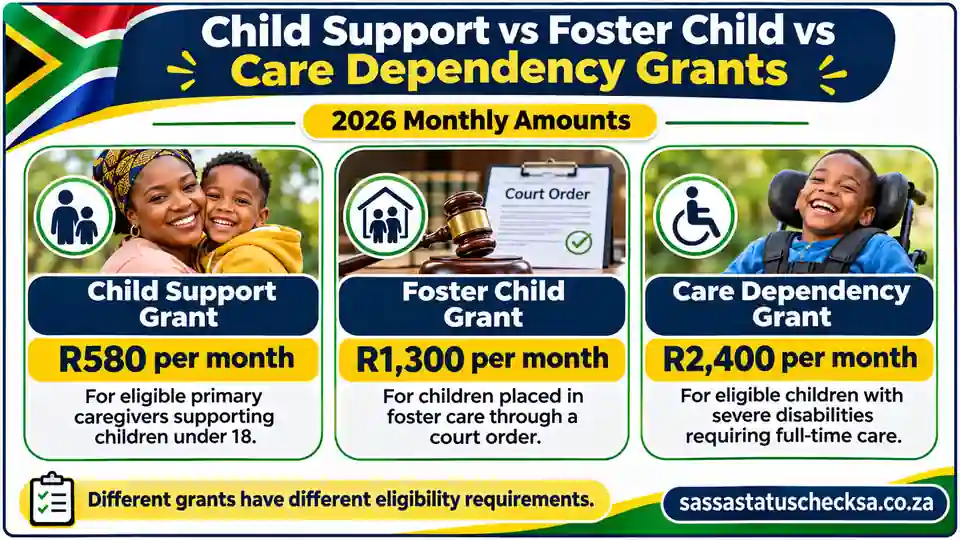
The ordinary Child Support Grant’s R290 orphan top-up is a separate additional amount for qualifying relative caregivers of orphaned children. When approved, it brings the standard R580 to R870 per month for that child. It is not automatically added to every child’s grant, and it does not turn a Child Support Grant into a Foster Child Grant.
If a child has been placed in your care by a court, review the SASSA foster child grant requirements rather than applying on the assumption that informal primary care and formal fostering are the same process.
Can a caregiver qualify for more than one type of grant?
A caregiver may receive a grant in their own name while claiming a different grant for an eligible child. However, applications for different child grants are assessed according to each benefit’s rules and the child’s circumstances. You should not assume that separate child-grant amounts can always be added together for the same child.
Important exception for foster parents
SASSA specifically allows an eligible foster parent caring for a child with a qualifying severe disability to receive both the Foster Child Grant and Care Dependency Grant for that same foster child, subject to the requirements of both benefits. This exception is why a blanket claim that two child grants can never be combined would be misleading.
For the medical-assessment and care requirements, read our guide to the care dependency grant for children with disabilities. If you are unsure which grant applies, ask SASSA to assess your specific situation before submitting another application.
Common caregiver questions
Frequently Asked Questions About the Child Support Grant
These answers cover day-to-day questions about who may claim, changes in care, payment arrangements and keeping a grant active. If SASSA has issued a decision in your particular case, follow the instructions in that decision or speak directly with the agency.
Can a father apply for the Child Support Grant?
Yes. The grant is not reserved for mothers. A father or another eligible person who is genuinely responsible for the child’s day-to-day care may apply if the caregiver, child and means-test requirements are met. SASSA may ask for proof of primary care.
Can a grandparent receive an Older Persons Grant and a Child Support Grant?
Potentially, yes. An Older Persons Grant is assessed for the qualifying grandparent, while a Child Support Grant is assessed for an eligible child in that person’s care. Each application has its own rules, so confirm the caregiver’s eligibility and how income is assessed with SASSA.
Is there a limit on the number of children a caregiver can claim for?
SASSA states a limit of six children who are not the caregiver’s biological or legally adopted children. This is not a six-child cap on every family regardless of parentage. Each child’s eligibility is considered separately.
Will a child lose the grant if a school letter is missing?
A missing school-attendance letter alone should not automatically cause an otherwise eligible Child Support Grant application to be refused. Provide available school or clinic records when SASSA requests them, and follow up if the agency needs other evidence about the child’s care.
What should I do if the child moves to a different caregiver?
Tell SASSA promptly and explain the new living and care arrangements. The person receiving the grant must remain the appropriate primary caregiver. SASSA may need to review the existing grant and determine whether the new caregiver can apply.
Can I change the bank account used for my Child Support Grant?
Ask SASSA about its current process for updating payment details and use only an official, verified channel. The SRD R370 banking-details procedure is a separate service and should not be assumed to update a permanent Child Support Grant. Never share an OTP or bank password with this website.
Is child maintenance from the other parent the same as this grant?
No. Child maintenance is support owed or provided by a parent, while the Child Support Grant is a means-tested social grant administered by SASSA. Disclose any maintenance and other relevant income honestly when applying so SASSA can assess the applicable rules.
Is the orphan top-up paid automatically?
No. The additional R290 is for eligible relative caregivers of qualifying orphaned children. SASSA must check the family circumstances and required proof. Ask about the top-up and the acceptable evidence; it is not a general R290 increase for all children.
What happens when the child turns 18?
The ordinary Child Support Grant ends at the end of the month in which the child turns 18. It does not automatically convert into an SRD grant or another adult benefit. Any other support must be considered under that programme’s own eligibility rules.
Do I have to pay an agent to apply for a Child Support Grant?
No. Applying through SASSA is free. Do not pay someone who promises guaranteed approval or asks for banking PINs or verification codes. For a genuine application or correction, follow the official SASSA service instructions.
SASSA Status Check SA is an independent information website, not SASSA. We do not accept applications, check private grant records, or decide whether a caregiver qualifies.